
Table of Contents
- In This Article
- What’s Changed for Multifamily Buyers in LA
- Where a Standard Inspection Falls Short
- The Compliance Layer
- RHHP Status (Unincorporated Areas)
- SB 721 Balcony Inspections (3+ Units)
- SCEP (City of LA)
- RSO and Rent Stabilization
- AB 628 Appliance Requirements
- Cooling Mandate (82°F Rule)
- The Permit Problem
- The Physical Assessment
- CapEx Forecasting
- What to Request During Due Diligence
- The Bottom Line
- Additional Resources
- Related Articles
- Contact Information
In This Article
- What’s Changed for Multifamily Buyers in LA
- Where a Standard Inspection Falls Short
- The Compliance Layer
- The Permit Problem
- The Physical Assessment
- CapEx Forecasting
- What to Request During Due Diligence
- The Bottom Line
What’s Changed for Multifamily Buyers in LA
If you bought a multifamily property in Los Angeles five years ago, your due diligence was mostly about the building’s physical condition and the rent roll. Was the roof sound? Were the mechanicals aging out? Did the income justify the price?
Those questions still matter. But in 2026, they are not enough. Los Angeles has layered on a series of compliance obligations that transfer with the deed , and if you don’t identify them before you close, you inherit them at full cost.
RHHP inspections are now active across unincorporated LA County, with every occupied unit subject to a 4-year inspection cycle. SB 721 requires balcony inspections for any building with three or more units, and the initial deadline has passed, meaning noncompliant buildings are already behind. AB 628 requires stoves and refrigerators in every rental unit as of January 2026. The eviction threshold was just raised. The RSO formula changed February 1. And roughly 40% of the multifamily properties I inspect in older neighborhoods have some form of unpermitted work.
None of this shows up in a standard home inspection report. All of it affects your bottom line.
Where a Standard Inspection Falls Short
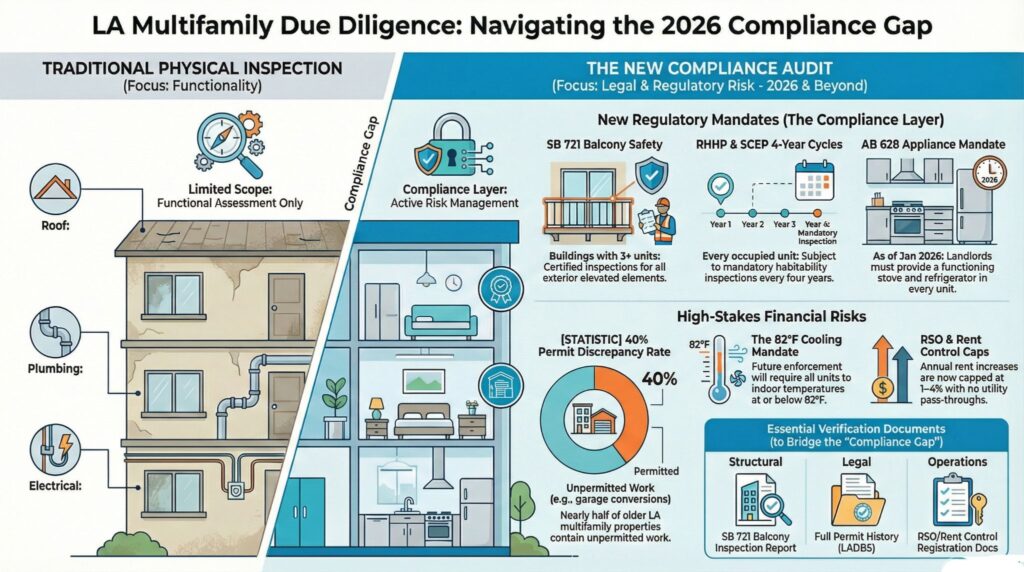
A standard property inspection tells you whether things are functional. It checks the roof, plumbing, electrical, HVAC, and structure. It identifies defects. For a single-family home, that is usually sufficient.
For a multifamily investment property, it is a starting point , not an endpoint. A standard inspection won’t tell you whether the building is compliant with current regulatory obligations. It won’t tell you whether the fourplex has an unpermitted ADU that could trigger enforcement. It won’t tell you that the balcony decking is 25 years old and the seller never completed the SB 721 inspection that was due in January 2025.
The gap between “functional” and “compliant” is where multifamily buyers get surprised after closing.
The Compliance Layer
Here’s what a multifamily due diligence inspection in LA should evaluate beyond standard physical condition:
RHHP Status (Unincorporated Areas)
If the property is in unincorporated LA County , East Los Angeles, Altadena, Lennox, Florence-Firestone, Hacienda Heights, Willowbrook, and others, it is subject to the Rental Housing Habitability Program. Every occupied unit will be inspected on a 4-year cycle. Before you buy, you should know: Has the property already been inspected? If so, were violations found? Were they corrected? Is there an upcoming inspection in the pipeline? If the seller has outstanding violations, those become your violations on the day you close.
SB 721 Balcony Inspections (3+ Units)
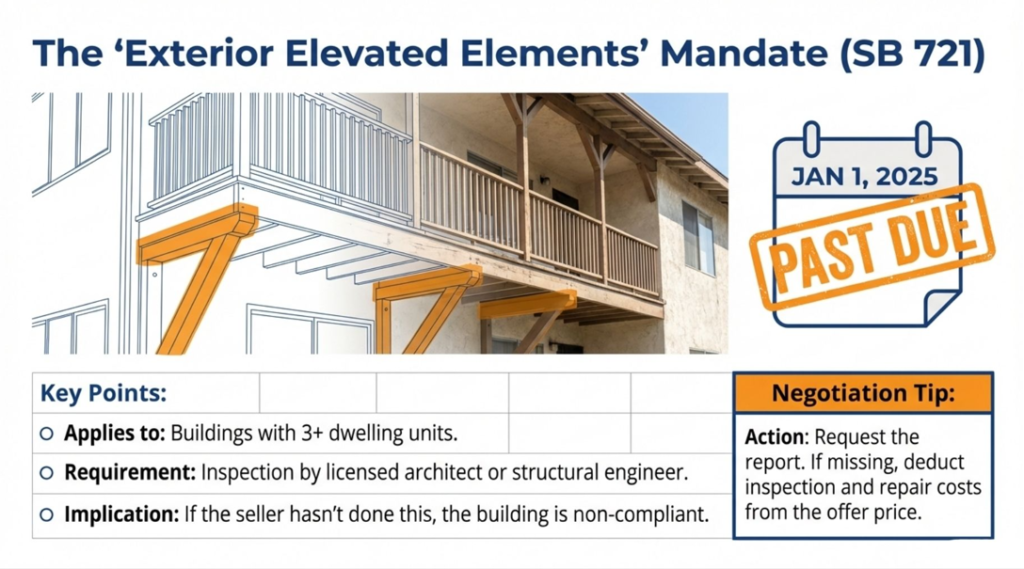
Any building with three or more dwelling units and exterior elevated elements ,balconies, decks, exterior stairs, walkways—must have a completed SB 721 inspection. The initial deadline was January 1, 2025. If the seller did not complete it, you are buying a building that is already out of compliance. The inspection must be performed by a licensed architect, structural engineer, or contractor with the appropriate credentials. Request the completed report during due diligence. If it doesn’t exist, factor the cost into your offer.
SCEP (City of LA)
If the property is in the City of Los Angeles, the Systematic Code Enforcement Program applies to all residential buildings with two or more units. The City inspects on a roughly 4-year cycle, and the property’s inspection history is available through LADBS. Outstanding violations, open cases, and REAP status should all be checked before you close.
RSO and Rent Stabilization
Does the property fall under the LA City RSO? Under AB 1482? Under a local rent control ordinance? The rules governing what you can charge, how you can raise rents, and what constitutes just-cause eviction vary dramatically depending on jurisdiction and building age. If you are buying a building with below-market rents under RSO, you need to understand that the annual increase cap is now 1–4% and utility pass-throughs have been eliminated as of February 2026.
AB 628 Appliance Requirements
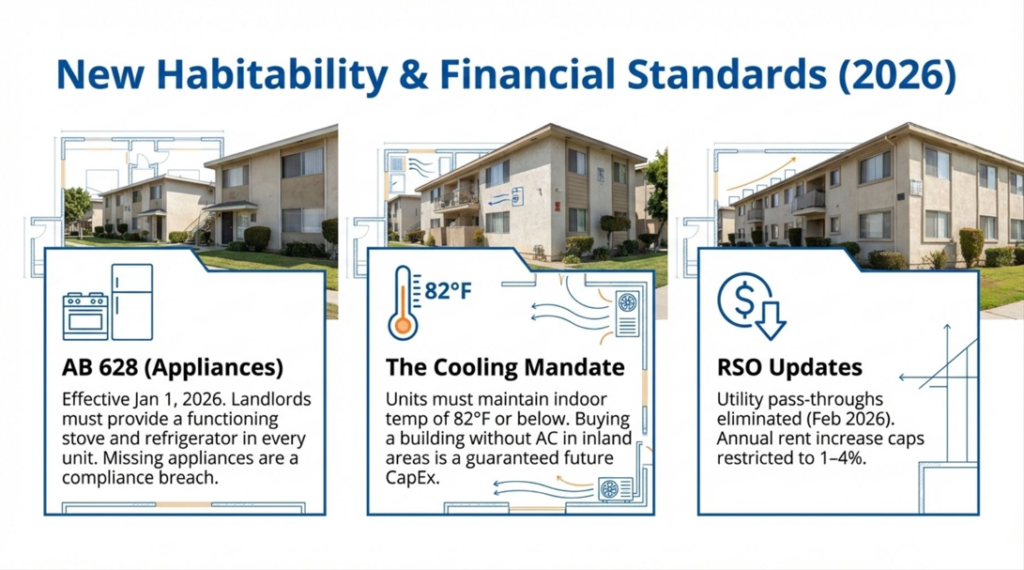
As of January 1, 2026, every rental unit in California must have a functioning stove and refrigerator provided by the landlord. If the building you are buying has units without these appliances, that is an immediate compliance issue you will need to address.
Cooling Mandate (82°F Rule)
LA County’s cooling mandate requires that rental units be able to maintain an indoor temperature of 82°F or below. RHHP inspectors are currently evaluating this during inspections, with full enforcement coming in 2027. If you are buying a building without air conditioning in a hot inland area, this is a future capital expense you need to account for.
The Permit Problem
This is the issue I see more than any other in multifamily due diligence, and it is the one most buyers underestimate.
Roughly 40% of the multifamily properties I inspect in older LA neighborhoods have some form of unpermitted work. Converted garages, enclosed patios, added bathrooms, split units, informal ADUs—the variety is endless. Sometimes the seller knows about it. Sometimes they don’t. Sometimes they know but hope you won’t notice.
Why Unpermitted Work Matters More Now
Unpermitted work has always been a risk, but the consequence profile has changed. RHHP inspectors are now entering every unit in unincorporated areas. If they find work that doesn’t match the permit record, that triggers a different conversation than a standard habitability check. And with tenants increasingly using public databases to check their own unit’s legal status, the days of quiet noncompliance are numbered.
Before you close on a multifamily property, pull the permit history. Compare what is permitted to what is physically there. If there are discrepancies, you need to understand the cost and feasibility of bringing the work into compliance,or the risk of operating with it as-is.
The Physical Assessment
The compliance layer doesn’t replace the physical inspection,it adds to it. For multifamily buildings, the physical assessment should go deeper than a single-family checklist:
- Roof condition and remaining useful life. On a 20-unit building, a roof replacement is a six-figure expense. Know what you are buying.
- Plumbing supply and drain materials. Galvanized supply lines and cast iron drain lines are common in pre-1970 LA buildings. Both have finite lifespans and expensive replacement costs.
- Electrical panel capacity and wiring type. Buildings with Federal Pacific or Zinsco panels, or with aluminum branch wiring, have specific risks and insurance implications.
- Common area conditions. Hallway lighting, laundry room ventilation and drainage, parking structure condition, stairwell and walkway integrity. These are shared-cost items that affect all units.
- Unit-by-unit variation. Unlike a single-family home, not every unit in a multifamily building is in the same condition. Deferred maintenance is often concentrated in specific units,typically the ones with long-term tenants who stopped reporting issues years ago.
- Exterior elevated elements. Even if SB 721 doesn’t apply (less than 3 units), the condition of balconies, decks, stairs, and walkways is a safety and liability concern.
- Seismic retrofit status. Soft-story buildings in the City of LA were required to retrofit under the city’s mandatory program. Verify compliance if applicable.
CapEx Forecasting
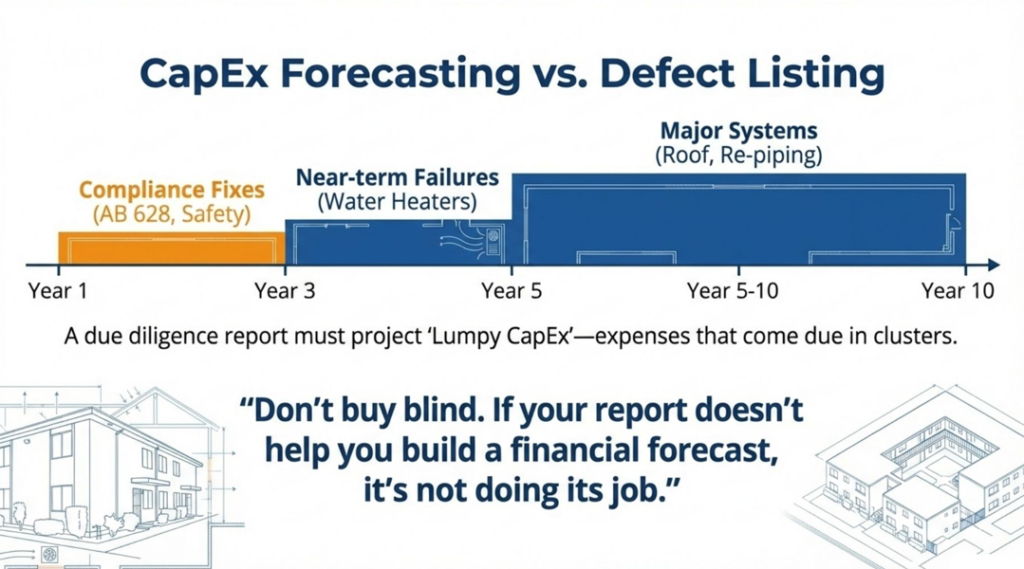
A good due diligence inspection doesn’t just tell you what is wrong today. It tells you what will need attention in the next 3, 5, and 10 years. This is especially important for multifamily properties where capital expenses are lumpy , roofs, plumbing, electrical panels, and exterior waterproofing tend to come due in clusters on buildings of the same era.
Your inspection report should give you enough information to build a capital expenditure forecast. If it doesn’t, you are buying blind.
What to Request During Due Diligence
Documents to Request from the Seller
- All permits pulled in the last 20 years (or full permit history if available)
- SB 721 inspection report (if applicable)
- RHHP inspection results (if in unincorporated LA County)
- SCEP inspection history (if in City of LA)
- Rent roll with unit details, lease terms, and current rents
- RSO/rent control registration documentation
- Seismic retrofit compliance documentation (if applicable)
- Maintenance logs and contractor records
- Insurance claims history
- Utility bills for common areas (12 months)
- Any outstanding code enforcement cases or violations
What to Verify Independently
- Permit history through LADBS or the applicable building department
- Zoning verification, is the current use legal?
- REAP status (City of LA) or complaint history
- Fire Hazard Severity Zone designation (for insurance and AB 38 implications)
- Flood zone mapping
- Property tax assessment vs. stated operating expenses
The Bottom Line
Due diligence on a multifamily property in LA is no longer just a physical inspection. It’s a compliance audit, a permit investigation, and a capital planning exercise, all at once. The regulatory landscape has shifted enough that what you don’t know absolutely can hurt you , and the cost of discovering problems after closing is always higher than discovering them before.
The buyers who are making smart acquisitions right now are the ones who treat due diligence as an investment, not a checkbox. They want to know not just “is this building in good shape?” but “what am I inheriting, what will it cost me, and what is coming next?”
If you are evaluating a multifamily property and want a due diligence inspection that covers both the physical condition and the compliance landscape, that is exactly what we do. Happy to walk through what the process looks like for your specific property.
NS
Additional Resources
Related Articles
- Due Diligence Inspections for Multifamily Buyers
- Why I Always Pull Permit Records
- What Actually Fails an SB 721 Balcony Inspection
- AB 628: Landlords Must Provide Stoves and Refrigerators
Contact Information
- Phone/Text: (626) 214-5929
- Email: nathan@larentalinspections.com
- Website: labuildinginspections.com
Get Ahead of Your Inspection
Book an inspection today and get ahead of your inspection. We'll help you get the most out of your inspection.
Schedule InspectionQuestions?
Email: nathan@larentalinspections.com
Call/Text: (626) 214-5929
Serving all of Los Angeles County