

Table of Contents
I’m not an attorney, and this isn’t legal advice. But I inspect rental properties for a living, and I see what happens after my reports get delivered. Increasingly, what happens is a lawyer gets involved.
Not the landlord’s lawyer. The tenant’s.
There is a large and growing number of attorneys in Los Angeles who focus exclus
ively on tenant habitability cases. They advertise on Google, on social media, and in tenant advocacy networks. Some of them are excellent. Some are aggressive. All of them are busy. And the regulatory environment in LA is feeding them more cases than they’ve ever had.
If you own rental property in Los Angeles, you need to understand how this industry works, because understanding it is the first step to making sure you never end up on the receiving end of a demand letter.
The Business Model
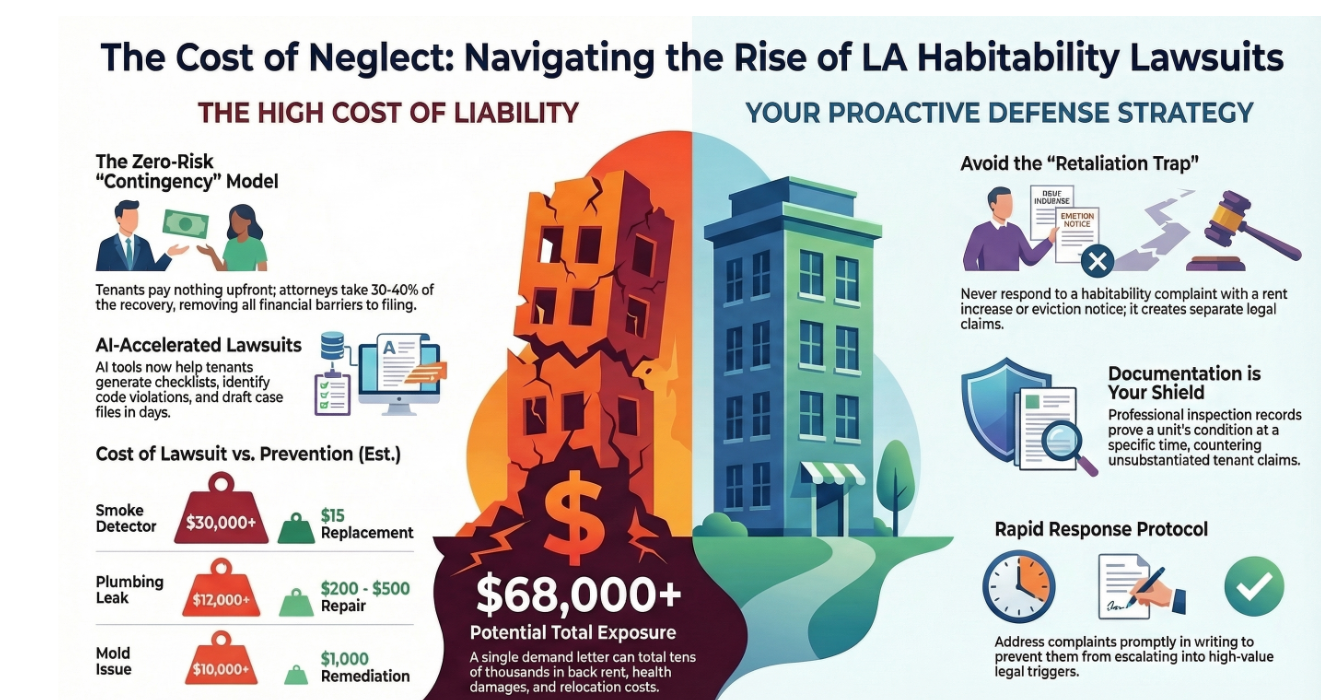
Most habitability attorneys work on contingency. That means the tenant pays nothing upfront. No retainer. No hourly fees. No cost to walk in the door and start a case.
The attorney takes a percentage of whatever they recover, typically 30% to 40%. If they don’t recover anything, the tenant owes nothing. This is important to understand because it removes the single biggest barrier that used to prevent tenants from pursuing claims: cost.
Five years ago, a tenant with a mold problem or missing smoke detectors would have to weigh whether it was worth hiring a lawyer at $300 to $500 per hour. Most decided it wasn’t. They lived with the problem or moved out.
Today, that same tenant can walk into a habitability attorney’s office with zero financial risk. The attorney evaluates the case, and if there’s documented evidence of habitability violations, they take it. The tenant’s only investment is their time.
This is why the volume of habitability cases in Los Angeles has grown significantly. The business model makes it possible for any tenant with a legitimate complaint to pursue it, regardless of their financial situation.
What the Demand Letter Looks Like
When a habitability attorney takes a case, the first thing that happens is a demand letter. If you’ve never received one, here is what it typically includes:
Back Rent
The attorney will argue that the unit was partially or fully uninhabitable for some period of time, and that the tenant is entitled to a rent reduction for that entire period. If the tenant has been living with mold for 18 months and paying $2,000 per month, the demand might include 12 to 18 months of partial rent refund. Even at 50% reduction, that’s $12,000 to $18,000.
Damages for Health Impacts
If the habitability issue affected the tenant’s health, the demand will include damages. Mold exposure, respiratory issues, pest-related health problems. These claims can range from a few thousand dollars to tens of thousands, depending on severity and documentation.
Emotional Distress
Living in a unit with serious habitability issues causes stress, anxiety, and disruption. Attorneys include emotional distress damages in nearly every habitability case. The amounts vary, but they add up.
Relocation Costs
If the tenant had to move out due to uninhabitable conditions, the attorney will demand moving costs, temporary housing costs, and the difference in rent if the new unit is more expensive. In LA’s rental market, this can be substantial.
Attorney’s Fees
Here is the part that surprises most landlords: under certain California statutes, the losing party pays the winning party’s attorney’s fees. If you lose a habitability case, you may be paying for your attorney AND the tenant’s attorney. At $300 to $500 per hour, legal fees alone can reach $20,000 to $50,000.
What a Demand Letter Can Total
Back rent (18 months at 50% reduction) $18,000
Health impact damages $10,000
Emotional distress $5,000
Relocation costs $5,000
Attorney’s fees (both sides) $30,000
Potential total exposure $68,000+
These are illustrative numbers, not guarantees. Actual amounts depend on the severity, duration, and documentation of violations. Some cases settle for less. Some result in more.
Compare that to the cost of fixing the underlying issues. A smoke detector replacement: $15. A plumber visit: $200 to $500. Mold remediation caught early: $1,000 to $3,000. The math is not complicated.
How AI Changed Their Pipeline
The habitability attorney business model has always existed. What has changed is the speed and volume of their intake pipeline.
Before AI, a tenant who suspected habitability issues had to figure things out on their own. They had to identify what was wrong, research whether it was a code violation, understand their rights, and find an attorney. Most people stalled somewhere in that process. The friction was high enough that many legitimate cases never became cases.
AI has removed almost all of that friction.
A tenant can now ask ChatGPT to generate a habitability checklist, walk their unit with it, photograph everything that looks wrong, ask AI to identify which code sections apply, have AI draft a timeline of events and a demand letter, and then show up at a habitability attorney’s office with a case file that is 80% assembled.
From the attorney’s perspective, this is transformative. Instead of spending hours on intake and investigation, they’re receiving organized, documented cases from tenants who already understand the basics. The attorney evaluates the evidence, confirms the legal theory, and sends the demand letter. The entire process from tenant suspicion to demand letter has compressed from weeks or months to days.
This means more cases are being filed. It means attorneys can handle higher volume. And it means landlords who have been getting away with deferred maintenance are running out of time.
What Triggers the Call to an Attorney
Based on the inspections I conduct, the situations that most commonly end up with an attorney involved are:
Unaddressed complaints. The tenant reported a problem. The landlord ignored it or gave a response that felt dismissive. The tenant decided to escalate. This is the most common trigger by far.
Health-related conditions. Mold, pest infestations, gas leaks, CO exposure, lead paint. Anything that affects the tenant’s health escalates faster because the damages are higher and the urgency is real.
Safety hazards. Exposed electrical, non-functional smoke detectors, broken locks, missing handrails. Conditions where someone could get hurt. If someone does get hurt, the case goes from habitability to personal injury, and the numbers get dramatically larger.
Retaliation. The tenant complained about conditions, and the landlord responded by raising rent, issuing a notice, or threatening eviction. Retaliation claims compound habitability claims and increase damages significantly.
Discovery of broader non-compliance. A tenant starts looking into one issue and discovers others. They find out the unit isn’t in the rent registry, or the building has unpermitted work, or the property isn’t enrolled in RHHP or SCEP. What started as a mold complaint becomes a comprehensive compliance case.
The Retaliation Trap
The worst thing a landlord can do when a tenant raises habitability concerns is respond with any action that could be interpreted as retaliatory. Serving a rent increase, a 3-day notice, or threatening eviction after a complaint doesn’t just look bad. It creates a separate legal claim with its own damages. Address the underlying condition. Document your response. Do not escalate.
The Landlord’s Math
I want to be direct about why this matters financially.
A landlord with 10 units who defers maintenance on basic habitability items is not saving money. They are accumulating liability. Every month that a smoke detector stays expired, that a leak goes unaddressed, that mold grows behind a wall, the potential damages in a habitability lawsuit increase.
The damages are calculated based on duration. A condition that existed for 6 months creates a claim for 6 months of reduced habitability. A condition that existed for 3 years creates a claim for 3 years. The longer you defer, the more it costs when it catches up with you.
And the new regulatory environment accelerates discovery. Under RHHP and SCEP, the County and City are proactively inspecting rental units. Those inspections create official documentation of violations. That documentation is exactly what a habitability attorney needs to build a case. A landlord who fails an RHHP inspection and doesn’t correct the violations quickly is essentially creating evidence for the tenant’s lawyer.
Even without an official inspection, tenants are finding conditions on their own using AI-generated checklists. They’re photographing them. They’re documenting them with timestamps. And they’re bringing them to attorneys who work for free.
Your Best Defense
The best defense against a habitability lawsuit is to not have habitability violations. That sounds obvious, but it requires a level of ongoing attention that most landlords are not providing.
This means knowing the exact condition of every unit you own. Not last year. Right now. It means checking smoke detectors and CO alarms regularly and tracking replacement dates. It means testing water temperature. It means looking under sinks, checking GFCI outlets, verifying that windows and locks work. It means responding to tenant complaints promptly, in writing, with documentation of what you did and when.
It also means having your own documentation. If a habitability attorney sends a demand letter claiming mold has been present for 18 months, your defense is dramatically stronger if you have records showing you inspected the unit 6 months ago and the condition didn’t exist, or that you remediated it immediately when it was reported. Without that documentation, the tenant’s version of events is the only version.
Professional inspections on a regular basis create exactly this kind of record. They document the condition of each unit at a specific point in time, identify issues before they become claims, and create a paper trail that demonstrates good-faith maintenance.
This is not about being paranoid. It is about understanding that the legal environment has shifted, that tenants have more tools than ever, and that an entire industry of attorneys is positioned to capitalize on landlords who don’t keep up.
The Bottom Line
Habitability attorneys are not going away. The regulatory environment is giving them more cases. AI is giving them better-prepared clients. The contingency model ensures that any tenant with a legitimate claim can pursue it at zero cost.
The landlords who avoid these cases are the ones who treat compliance as an ongoing operation, not a one-time event. They know what’s in their units. They fix things before they become complaints. They document everything. And they understand that the cost of maintenance is always less than the cost of a lawsuit.
A $15 smoke detector or a $200 plumber visit is not an expense. It is insurance against a $50,000 demand letter.
Treat it accordingly.
NS
Nathan Sewell
LA Building Inspections & Compliance
Helping LA property owners understand building conditions, compliance requirements, and habitability standards. Professional inspections for rental properties, due diligence, and RHHP/SCEP preparation.
Build Your Defense
A documented inspection record is your strongest protection against habitability claims. We identify issues before they become lawsuits.
Questions?
Call: (626) 214-5929
Email: nathan@larentalinspections.com
Service Area: LA County & Orange County
LA Building Inspections
Get Ahead of Your Inspection
Book an inspection today and get ahead of your inspection. We'll help you get the most out of your inspection.
Schedule InspectionQuestions?
Email: nathan@larentalinspections.com
Call/Text: (626) 214-5929
Serving all of Los Angeles County