Table of Contents
- In This Article
- What AB 38 Requires
- Who Needs This Inspection
- Fire Hazard Severity Zones in LA County
- What Inspectors Actually Check
- The Home Hardening Disclosure
- Annual Brush Clearance vs. AB 38
- Timing and the Transaction
- How to Prepare Before Listing
- Where a Pre-Listing Property Assessment Fits In
- Sources and Additional Information
- Official Resources
- Related LA County Agencies
- Related Articles
In This Article
- What AB 38 Requires
- Who Needs This Inspection
- Fire Hazard Severity Zones in LA County
- What Inspectors Actually Check
- The Home Hardening Disclosure
- Annual Brush Clearance vs. AB 38
- Timing and the Transaction
- How to Prepare Before Listing
What AB 38 Requires
Assembly Bill 38 is a point-of-sale law. It took effect July 1, 2021, and it applies every time a residential property in a High or Very High Fire Hazard Severity Zone changes hands.
The requirement is straightforward: the seller must provide the buyer with documentation of a compliant defensible space inspection before close of escrow. The inspection must have been completed within six months of the sales contract. If the seller can’t obtain documentation by closing, the law allows the buyer and seller to enter a written agreement transferring the obligation to the buyer, who then has one year from close of escrow to obtain compliance.
This is a disclosure and documentation requirement, not a retrofit mandate. You’re not required to rebuild your home. You’re required to demonstrate that your property meets California’s defensible space standards under Public Resources Code Section 4291.
Who Needs This Inspection
AB 38 applies to residential properties with one to four units that require a Real Estate Transfer Disclosure Statement. If your property is in a designated High or Very High Fire Hazard Severity Zone, the inspection is required when you sell.
In simple words across LA County, this includes large portions of: the San Gabriel foothills (Altadena, La Cañada Flintridge, Sierra Madre, Monrovia, Duarte, Azusa), the Santa Monica Mountains (Malibu, Topanga, Pacific Palisades, Calabasas), the Verdugo Mountains (Glendale, La Crescenta, Sunland-Tujunga), the Santa Susana area (Chatsworth, Porter Ranch, Granada Hills), and hillside areas throughout the City of LA.
After the January 2025 fires, awareness of fire zones has increased dramatically among both buyers and agents. And in March 2025, CAL FIRE released updated Fire Hazard Severity Zone maps for LA County that expanded the number of affected parcels. Some properties that were not previously in a designated zone now are.
Check Your Zone
Use the CAL FIRE FHSZ Viewer to see if your property falls within a High or Very High Fire Hazard Severity Zone. The 2025 maps are the most current. If your property was recently reclassified, you may be subject to AB 38 even if previous sellers were not.
Fire Hazard Severity Zones in LA County
There are two systems to understand. In State Responsibility Areas (SRA)—typically unincorporated wildland areas—CAL FIRE maps three zones: Moderate, High, and Very High. In Local Responsibility Areas (LRA)—incorporated cities and county-managed urban areas—only the Very High Fire Hazard Severity Zone is designated.
AB 38 defensible space inspections apply in both High and Very High zones, in both SRA and LRA.
The distinction matters because different agencies conduct the inspections depending on jurisdiction. In unincorporated LA County, the LA County Fire Department handles AB 38 inspections. In incorporated cities like Malibu, you may need to go through LA County Fire’s Prevention Division. In the City of LA, LAFD manages the process. Each jurisdiction may have different fees, timelines, and scheduling procedures.
What Inspectors Actually Check
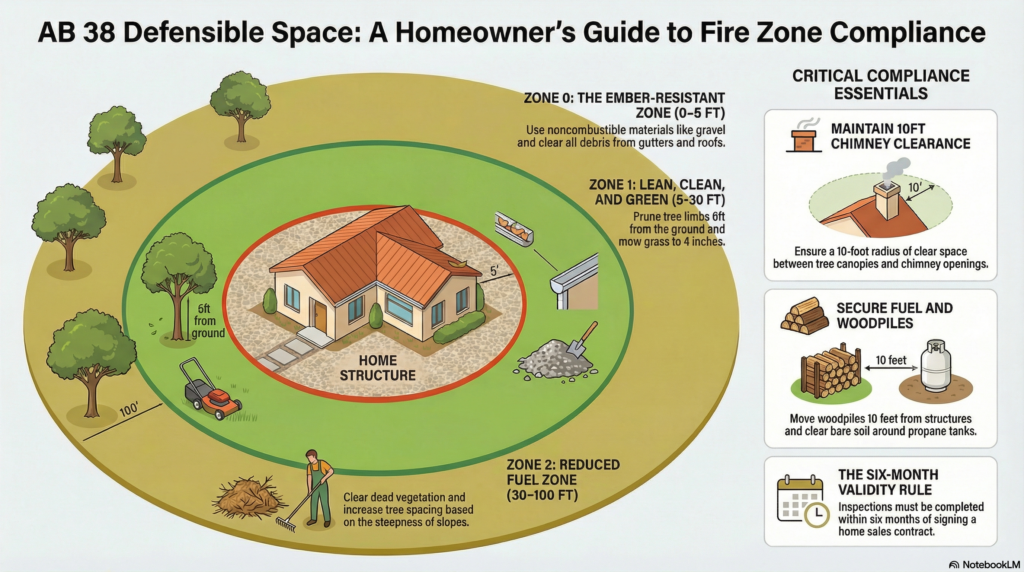
The defensible space inspection is based on PRC 4291, which requires 100 feet of defensible space around all structures. The inspection evaluates your property across three zones:
Zone 0: Ember-Resistant Zone
0–5 feet from structures
This is the most critical area. Inspectors want to see noncombustible materials—gravel, stone, concrete, bare soil. No bark mulch, no wood chips, no combustible planters touching the structure. Gutters and roofs must be clear of leaves and debris. No combustible items stored under decks or against walls. This zone was added in the latest update to PRC 4291 and is the area most likely to catch homeowners off guard.
Zone 1: Lean, Clean, and Green
5–30 feet from structures
Vegetation should be well-maintained and spaced. Grass and weeds mowed to 4 inches or less. Horizontal and vertical spacing between shrubs and trees to prevent fire from climbing. Dead plants, branches, and leaves removed. Tree limbs pruned at least 6 feet from the ground. No branches within 10 feet of chimney openings.
Zone 2: Reduced Fuel Zone
30–100 feet from structures
Reduced density of vegetation. Spacing between trees based on slope—steeper slopes require more spacing. Dead vegetation and fallen debris cleared. The goal is to reduce fire intensity and flame length so it is manageable when it reaches Zone 1.
Inspectors are also looking at overall property conditions: propane tank clearance (10 feet of bare soil around tanks), woodpile storage (10 feet of clearance), and clearance around outbuildings and accessory structures.
The Home Hardening Disclosure
AB 38 also introduced a home hardening disclosure requirement that took effect January 1, 2021. For properties in Very High Fire Hazard Severity Zones, the seller must disclose the property’s compliance with home hardening measures—fire-resistant roofing, enclosed eaves, tempered glass windows, and similar features.
The California Association of Realtors created the FHDS form (Fire Hardening and Defensible Space Advisory, Disclosure, and Addendum) for this purpose. This is a disclosure, not a pass/fail inspection. The seller states the property’s current condition with respect to hardening features; they are not required to retrofit the property, but they are required to disclose.
In practice, this means buyers in fire zones are now seeing exactly what protective measures the home does and doesn’t have. Post-January 2025, buyers and their agents are paying much closer attention to this form than they did before.
Annual Brush Clearance vs. AB 38
Many homeowners in fire zones are familiar with annual brush clearance requirements—the notices that come from LA County Fire or LAFD each spring requiring vegetation management. You need to know that the annual brush clearance program and the AB 38 point-of-sale inspection are related but separate obligations.
Annual brush clearance is an ongoing requirement. You receive a notice, you clear your vegetation, you get reinspected. AB 38 is triggered by a real estate transaction. But there is a useful overlap: if your property passed its annual defensible space inspection within six months of your sales contract, that inspection may satisfy the AB 38 documentation requirement. Check with your local fire agency to confirm.
The annual inspection schedule in LA County typically runs from April through summer. Inspections begin in desert communities around April 1, inland communities around May 1, and coastal communities around June 1. If you are planning to sell during these windows, coordinating your listing timeline with the annual inspection can save you the additional step of scheduling a separate AB 38 inspection.
Timing and the Transaction
The six-month window is the key constraint. The defensible space inspection must have been completed within six months of entering the sales contract. If you had an inspection done eight months before listing, it has expired and you need a new one.
Timeline Considerations
- Schedule early. Fire agencies can take 7–10 business days from request to inspection, and longer during peak spring/summer season. Do not wait until you are in escrow to request the inspection.
- Plan for reinspection. If your property doesn’t pass, you will need to make corrections and schedule a follow-up. Build this time into your listing timeline.
- Know your agency. Depending on whether you are in a city or unincorporated area, the inspecting agency is different. In unincorporated LA County, contact LA County Fire’s Prevention Division. In the City of LA, contact LAFD. In other cities, contact the local fire department.
- Fees vary. Some jurisdictions charge $100–$400+ per inspection. This is a seller cost.
If you can’t get the documentation by close of escrow, the law allows a written agreement transferring the compliance obligation to the buyer, who then has one year. In practice, many buyers are reluctant to accept this transfer post-2025—they want to see compliance before they close, not after. Your listing will be stronger with documentation in hand.
How to Prepare Before Listing
The best time to address defensible space is before you engage with the formal inspection process. Here’s what you can do:
Pre-Listing Defensible Space Checklist
- Clear all vegetation, debris, and combustible materials within 5 feet of every structure (Zone 0)
- Remove bark mulch and wood chips from Zone 0 and replace with gravel, stone, or decomposed granite
- Clean gutters, roofs, and decks of all leaves, needles, and debris
- Mow grass and weeds to 4 inches or less throughout Zone 1 (5–30 feet)
- Prune tree branches to at least 6 feet above ground
- Ensure 10 feet of clearance between tree canopies and chimneys
- Create horizontal and vertical spacing between shrubs and trees
- Clear dead vegetation, fallen branches, and leaf litter in Zone 2 (30–100 feet)
- Move woodpiles at least 10 feet from structures with bare soil clearance
- Ensure propane tanks have 10 feet of clearance to bare mineral soil
- Remove combustible items from under and around decks
- Verify address numbers are visible from the street (for fire department access)
Where a Pre-Listing Property Assessment Fits In
The official AB 38 defensible space inspection is conducted by your local fire agency. That’s the inspection whose documentation is required at close of escrow.
What a pre-listing property assessment can do is identify potential issues before you schedule the official inspection—the same way a pre-inspection identifies RHHP issues before the County inspector arrives. If your property has areas that may not meet clearance requirements, or if you are unsure about Zone 0 compliance, it is better to identify that on your timeline than to fail the fire agency’s inspection with a buyer waiting.
For properties in fire zones, a pre-listing assessment can also evaluate the home hardening features you will need to disclose on the FHDS form—roof material, eave enclosure, window glazing, vent screening, and exterior wall materials. Knowing what you are disclosing before you list helps you and your agent price and position the property accurately.
NS
Sources and Additional Information
Official Resources
- CAL FIRE Fire Hazard Severity Zone Maps: osfm.fire.ca.gov/fire-hazard-severity-zones
- California Public Resources Code Section 4291: Defensible Space Requirements
- Assembly Bill 38 (2020): Point of sale defensible space inspection requirements
- LA County Fire Department Prevention Division: For unincorporated area inspections
- California Association of Realtors FHDS Form: Fire Hardening and Defensible Space Advisory
Related LA County Agencies
- LA County Fire: (323) 890-4122
- City of LA Fire Department (LAFD): For City of LA properties
- Local City Fire Departments: Contact your city directly for jurisdiction specific requirements
Related Articles
- How to Pass Your RHHP or SCEP Inspection the First Time
- What California Homeowners Need to Know About the 2025 Insurance Crisis
- California Smoke and CO Detector Rules Changed
- Fire Separation Between Units in LA Multifamily Buildings
Nathan Sewell
LA Building Inspections & Compliance
Certified home inspector with an architecture background, specializing in fire zone property assessments, RHHP compliance, and rental property inspections throughout Los Angeles County.
Get Ahead of Your Inspection
Book an inspection today and get ahead of your inspection. We'll help you get the most out of your inspection.
Schedule InspectionQuestions?
Email: nathan@larentalinspections.com
Call/Text: (626) 214-5929
Serving all of Los Angeles County