
Table of Contents
- What’s Changed in Recent Years
- 2014: The 10-Year Sealed Battery Mandate
- 2016: Bedroom Placement Requirement
- 2022: Bathroom Proximity Rule
- Current Placement Requirements
- Smoke Alarms
- CO Alarms
- The 10-Year Sealed Battery Rule
- What’s NOT Required to Have Sealed Batteries
- Hardwired vs. Battery: When Each Applies
- New Construction Requires Hardwired
- Existing Buildings Can Use Battery-Only When:
- What Triggers Upgrades
- The $1,000 Permit Threshold
- LA City Has Higher Thresholds
- LA-Specific Requirements
- RHHP and SCEP Inspections
- Quick Compliance Checklist
- Smoke Detector Checklist
- CO Detector Checklist (if unit has gas appliances, fireplace, or attached garage)
- The Bottom Line
Smoke and CO detectors are the single most common violation I find in rental inspections—somewhere between 50-70% of units have at least one issue. Sometimes it’s a dead battery. Sometimes it’s a missing detector in a bedroom. Sometimes it’s a detector that’s 15 years old and should have been replaced years ago.
The rules have changed multiple times over the past decade, and what was compliant in 2010 isn’t compliant now. Here’s what California currently requires and what changed that catches landlords off guard.
What’s Changed in Recent Years
2014: The 10-Year Sealed Battery Mandate
Starting July 1, 2014, California law requires all battery-powered smoke alarms to have a non-replaceable, sealed 10-year battery. You can no longer sell or install smoke detectors with replaceable 9-volt batteries in California.
This was a big change. The old model—where tenants (or you) replaced batteries once a year—is gone. Now the battery is built in, lasts 10 years, and when it dies, you replace the entire detector.
2016: Bedroom Placement Requirement
As of January 1, 2016, all rental units in California must have smoke alarms installed per current building standards. The key change: smoke alarms are now required inside each bedroom, not just in the hallway outside bedrooms.
Older code only required alarms outside sleeping areas. Current code requires alarms both inside each bedroom AND outside each sleeping area. If your property was built before this change, you probably need to add detectors.
2022: Bathroom Proximity Rule
The 2022 California Residential Code added a requirement that smoke alarms must be installed at least 3 feet from bathroom doors containing a bathtub or shower. The reasoning: steam from bathrooms causes false alarms, and alarms placed too close to bathroom doors get disabled by frustrated tenants.
Current Placement Requirements
Smoke Alarms
Every dwelling unit needs smoke alarms in:
- Inside each bedroom (not optional—required in every sleeping room)
- Outside each sleeping area in the immediate vicinity of the bedrooms (the hallway)
- On each story of the dwelling, including basements
- In common stairwells of apartment complexes
For split-level units, an alarm on the upper level suffices for an adjacent lower level if the lower level is less than one full story below.
CO Alarms
Carbon monoxide alarms are required in any dwelling unit that has:
- A fossil fuel-burning heater or appliance (gas stove, water heater, furnace)
- A fireplace
- An attached garage
If your rental has any of these, you need CO alarms:
- Outside each sleeping area in the immediate vicinity of bedrooms
- On every level of the dwelling with bedrooms
Note that CO alarms are not required inside each bedroom—just outside the sleeping areas. But combination smoke/CO units installed in bedrooms satisfy both requirements.
The Attached Garage Trigger
Many landlords miss this: if your property has an attached garage, CO detectors are required even if there are no gas appliances. Car exhaust contains carbon monoxide, and an attached garage creates a potential pathway into the living space.
The 10-Year Sealed Battery Rule
Any battery-powered smoke alarm installed in California must have:
- A non-replaceable, non-removable battery capable of powering the alarm for at least 10 years
- The manufacture date displayed on the unit
- A place to write the installation date
- A “hush” feature to silence false alarms
The practical implication: you can’t just change the battery anymore. When the detector starts chirping at the end of its life, you replace the entire unit.
This also means any smoke detector manufactured more than 10 years ago needs to be replaced—check the date on the back of your detectors. Even if it still beeps when you test it, a detector past its expiration date won’t be accepted in an inspection.
What’s NOT Required to Have Sealed Batteries
- Hardwired smoke alarms (the backup battery can be replaceable)
- CO detectors (different standard)
- Smoke detectors connected to a monitored fire alarm panel
Hardwired vs. Battery: When Each Applies
New Construction Requires Hardwired
All new construction requires smoke alarms that are:
- Hardwired to the building’s electrical system
- Equipped with battery backup
- Interconnected so when one goes off, they all go off
This is straightforward for new buildings, but what about existing properties?
Existing Buildings Can Use Battery-Only When:
- No construction or alteration is taking place
- No commercial power source is available at the alarm location
- Interior wall or ceiling finishes are NOT removed exposing structure
- Work is limited to the exterior of the residence
- No attic, crawl space, or basement is available for running wires
In other words: if you’re not doing work that opens up walls, you can maintain battery-powered detectors. But if you’re doing renovation that exposes the structure, you may need to upgrade to hardwired.
What Triggers Upgrades
The $1,000 Permit Threshold
Here’s the rule that catches people: when a permit is required for alterations, repairs, or additions with a valuation exceeding $1,000, the individual dwelling unit must be equipped with smoke alarms meeting current code for new construction.
That means: if you pull a permit for work valued over $1,000 in a unit, that unit needs smoke alarms in all required locations—inside bedrooms, outside sleeping areas, on each level. Not just where alarms exist now, but where current code requires them.
LA City Has Higher Thresholds
LA City sets different permit thresholds:
- Apartments: Building permit valued at $3,000+ triggers retrofit requirements
- Houses/duplexes/condos: Building permit valued at $10,000+ triggers requirements
LA-Specific Requirements
LA City actually has stricter requirements than state code in one important way:
LA City Hardwired Requirement
In Los Angeles City, all existing buildings with 2+ dwelling units SHALL have smoke detectors permanently wired to building wiring (LAMC 91.8603). This exceeds the state standard that permits battery-only in certain existing building situations.
If you have an older apartment building in LA City with battery-only detectors, you may technically be out of compliance—though enforcement typically happens during permitted work or sale.
RHHP and SCEP Inspections
Both LA County’s RHHP program and LA City’s SCEP program check smoke and CO detectors. They’re looking for:
- Working detectors in all required locations
- Detectors that haven’t expired (check manufacture date)
- CO detectors where required (units with gas appliances or attached garage)
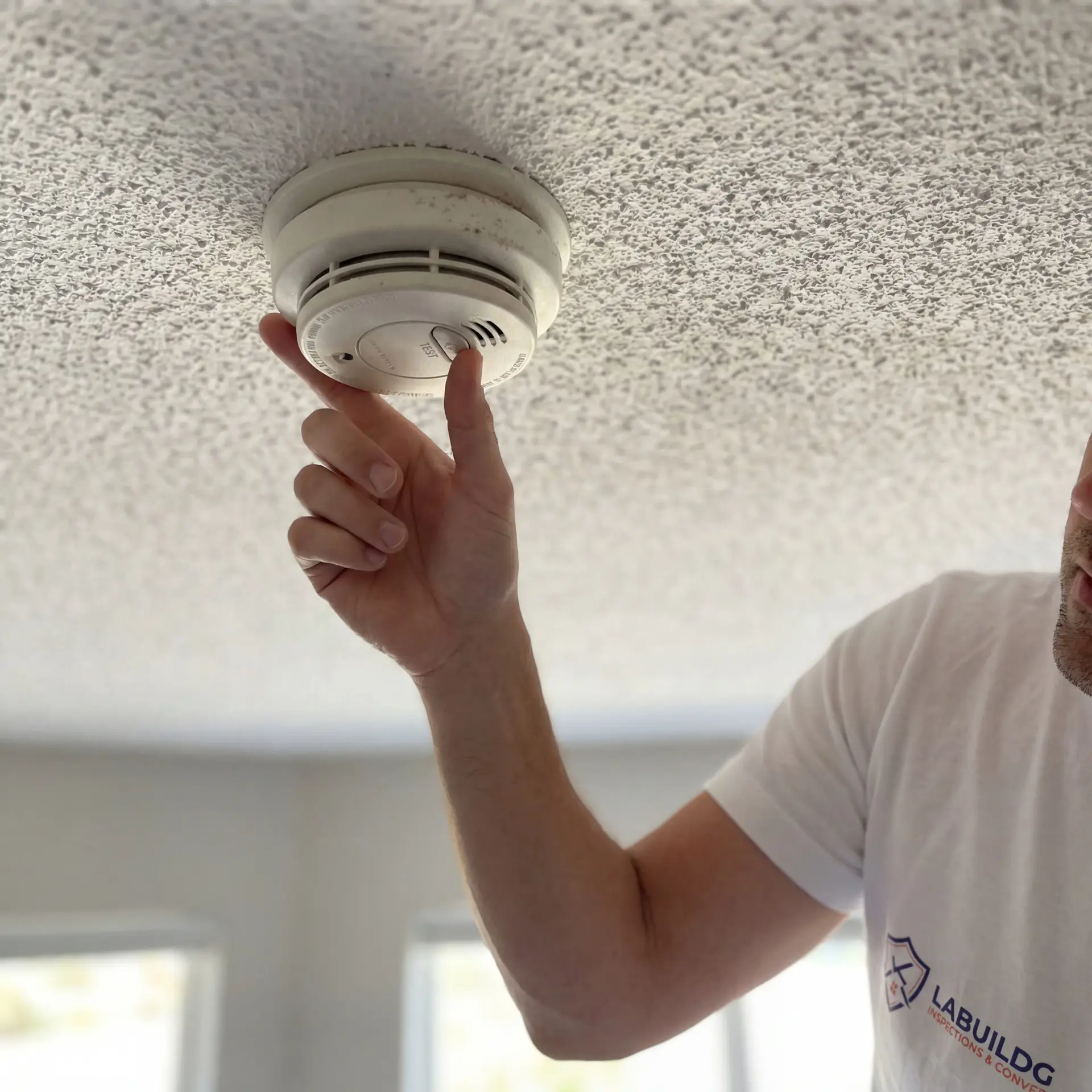
- Functional test button response
Missing or non-functional detectors are among the most cited violations. The good news: they’re cheap and easy to fix.
Quick Compliance Checklist
Smoke Detector Checklist
- Detector inside each bedroom
- Detector outside sleeping areas (hallway)
- Detector on each level including basement
- All detectors manufactured within last 10 years
- All battery units have 10-year sealed batteries
- Detectors at least 3 feet from bathroom doors
- Test button produces audible alarm
CO Detector Checklist (if unit has gas appliances, fireplace, or attached garage)
- Detector outside each sleeping area
- Detector on each level with bedrooms
- Detector not expired (check date—typically 5-7 year life)
- Test button produces audible alarm
The Bottom Line
Smoke and CO detector violations are the easiest violations to prevent. A detector costs $25-40. Checking the manufacture date takes 30 seconds. Testing the alarm takes one second.
Walk your units and check every detector. Replace anything over 10 years old. Add detectors to bedrooms if they’re not there. Make sure CO detectors are present if the unit has gas appliances or an attached garage.
This is one area where spending $100-200 before an inspection can prevent a failed inspection and a compliance deadline.
Get Ahead of Your Inspection
Book an inspection today and get ahead of your inspection. We'll help you get the most out of your inspection.
Schedule InspectionQuestions?
Email: nathan@larentalinspections.com
Call/Text: (626) 214-5929
Serving all of Los Angeles County