
Table of Contents
- In This Article
- Why This Law Exists
- What SB 610 Requires
- The Uninhabitability Presumption
- Rent During Disasters and Evacuations
- During mandatory evacuations
- During remediation
- If the unit is destroyed
- The Tenant’s Right to Return
- What SB 610 Does Not Require
- Why This Matters Especially in LA
- Your Action Plan
- The Bottom Line
- Additional Resources
- Related Articles
- Contact
In This Article
- Why This Law Exists
- What SB 610 Requires
- The Uninhabitability Presumption
- Rent During Disasters and Evacuations
- The Tenant’s Right to Return
- What SB 610 Does Not Require
- Why This Matters Especially in LA
- Your Action Plan
Why This Law Exists
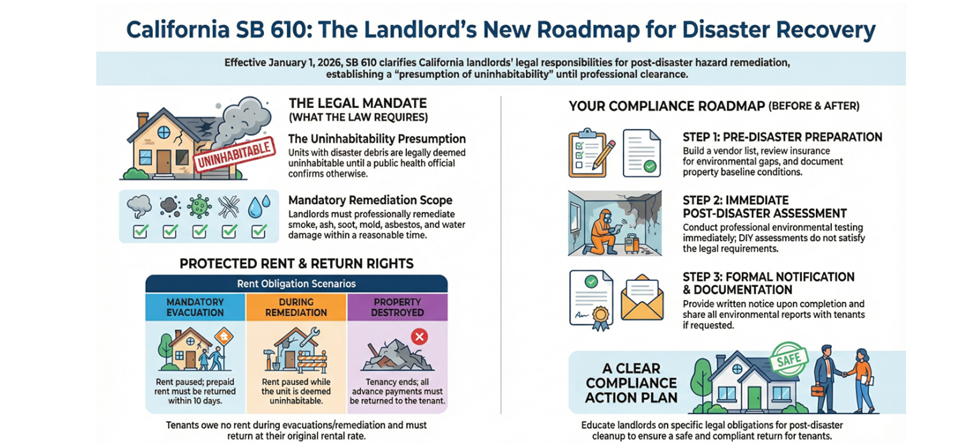
In January 2025, the Palisades and Eaton fires burned nearly 37,500 acres, destroyed or damaged close to 18,000 structures, and displaced approximately 13,000 households across Los Angeles County. But the devastation was not limited to the homes that burned down. Thousands of rental units that remained standing were coated in toxic ash—containing lead, asbestos fibers, and other hazardous materials.
What followed was confusion. Some landlords refused to clean up, saying it was not their responsibility. Some local officials gave tenants conflicting guidance. In Pasadena, a city official told renters during a public meeting that they were responsible for cleaning the inside of their own units. The city later contradicted that statement when pressed by reporters. In the City of LA, the Housing Department confirmed that landlords are obligated to remediate hazardous ash—but many landlords never heard that guidance.
The result: tenants were stuck. Some paid for their own environmental testing out of pocket. Some left and never came back. Some stayed in contaminated homes for months.
State Senator Sasha Renée Pérez introduced SB 610 to eliminate the ambiguity. Governor Newsom signed it into law in October 2025. It took effect January 1, 2026.
What SB 610 Requires
The law is straightforward. When a natural disaster causes damage to a residential rental property, it is the duty of the landlord to remediate hazards arising from that disaster. The law specifically names:
- Mold
- Smoke
- Smoke residue
- Smoke odor
- Ash
- Asbestos
- Water damage
The remediation must be done “within a reasonable time” and according to “specified cleaning protocols.” That means you can’t just wipe surfaces with a rag and call it done. If the disaster involved toxic materials—and post-fire ash in urban areas almost always does—the cleanup must follow the standards set by the relevant local or state health agencies.
The Uninhabitability Presumption
This is the part of the law that carries the most practical weight.
Key Legal Presumption
SB 610 creates a legal presumption that any rental unit affected by disaster debris is uninhabitable—until a local public health agency or official determines that the debris doesn’t contain toxic substances.
Read that carefully. The default position is that your unit is not habitable if disaster debris is present. You have to prove otherwise—not through your own assessment, but through an official determination from a public health authority.
This is a significant shift. Before SB 610, the landlord’s obligation to address disaster damage was implied through existing habitability statutes, but it was not explicit. Landlords could argue about scope, responsibility, and what counted as “habitable.” That argument is now much harder to make.
Rent During Disasters and Evacuations
SB 610 addresses rent obligations in three scenarios:
During mandatory evacuations
Rent is not owed for any period during which the tenant is under a mandatory evacuation order. If the tenant already paid rent covering that period, the landlord must return it within 10 calendar days after the evacuation order is lifted. Alternatively, the tenant can deduct the amount from the next month’s rent.
During remediation
If the unit is presumed uninhabitable due to disaster debris and the landlord is performing remediation work, the tenant shouldn’t be living in the unit. The practical effect is the same as an evacuation—the unit is not habitable, and rent obligations are paused.
If the unit is destroyed
If the rental property is destroyed or damaged to the point that the tenancy is terminated, the landlord must return any advance rental payments the tenant made covering periods after termination. This was a gap in prior law—some tenants had prepaid rent on units that no longer existed and had difficulty recovering those payments.
The Tenant’s Right to Return
Unless the tenancy is lawfully terminated by either party, the tenant has the right to return to the rental unit at the same rental rate that was in effect immediately before the disaster, as soon as it is safe and practicable.
This means you can’t use a disaster as an opportunity to reset the rent. If your tenant was paying $1,800 before the fire, they return at $1,800. This provision works alongside existing anti-price-gouging laws that were heavily discussed after the January 2025 fires.
The landlord must also notify the tenant in writing once remediation is complete and the unit is ready for reoccupation. The tenant has the right to view and obtain copies of any environmental studies, testing, or reports that were conducted during the cleanup.
What SB 610 Does Not Require
The law explicitly states that it does not require a landlord to rebuild a property that has been destroyed. If a fire levels your building, you are not obligated to reconstruct it under SB 610. Your obligation is to remediate hazards in units that are still standing and can be made habitable again.
It also doesn’t override the landlord’s right to lawfully terminate a tenancy through proper legal channels. If you decide not to rebuild and want to formally end the lease, you can do so through existing procedures. What you can’t do is simply stop communicating and hope the tenant goes away.
Why This Matters Especially in LA
Los Angeles is not done dealing with fire. The January 2025 fires were catastrophic, but they are part of a pattern. Fire season has been extending, drought conditions persist, and the urban-wildland interface continues to expand.
If you own rental property in Altadena, Pasadena, the foothills, or any area adjacent to open space or hillsides, the probability of another fire event affecting your property is not hypothetical. SB 610 gives you a clear framework for what happens when it does.
There’s also a connection to your existing RHHP and habitability obligations. Mold and water damage are among the most common RHHP violations. Post-disaster mold growth—from fire suppression water, broken pipes, or roof damage—triggers both SB 610 and your ongoing habitability requirements. If RHHP inspectors arrive and find unaddressed post-disaster mold, that is a violation regardless of the cause.
Your Action Plan
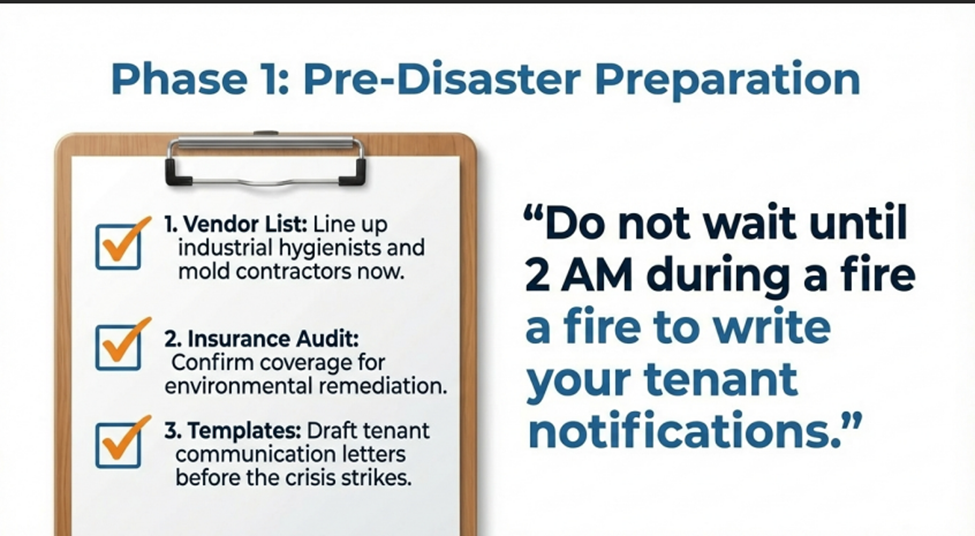
Before a Disaster
- Build a vendor list now. Identify environmental testing companies, mold remediation contractors, and general contractors in your area who can respond quickly. After a disaster, these services book up within days.
- Review your insurance coverage. Confirm your policy covers environmental remediation. Many standard landlord policies have significant gaps for smoke, ash, and toxic substance cleanup.
- Document your property’s current condition. Photos and reports of the property’s baseline condition make it easier to identify disaster damage and document remediation work. A maintenance inspection creates this record.
- Prepare communication templates. Draft a letter to tenants explaining your plan for disaster response. When a fire happens at 2 AM, you won’t be writing communications from scratch.
After a Disaster
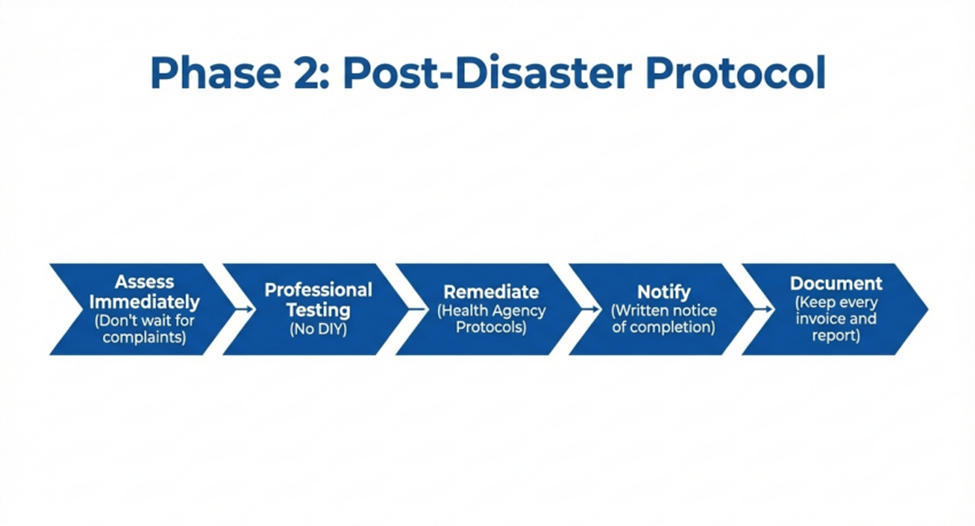
- Assess immediately. Do not wait for tenants to complain. If ash, smoke, or water has affected your property, start documenting and assessing the scope within days.
- Get professional testing. The uninhabitability presumption is only overcome by an official public health determination. DIY assessments don’t satisfy the law.
- Remediate according to protocols. Follow the cleaning standards issued by the relevant public health agency, not general cleaning practices.
- Notify tenants in writing. Once remediation is complete, you are required to provide written notice to the tenant. Include copies of environmental reports if the tenant requests them.
- Document everything. Keep records of all testing, remediation work, contractor invoices, health agency communications, and tenant notifications. If this ever goes to court, your documentation is your defense.
The Bottom Line
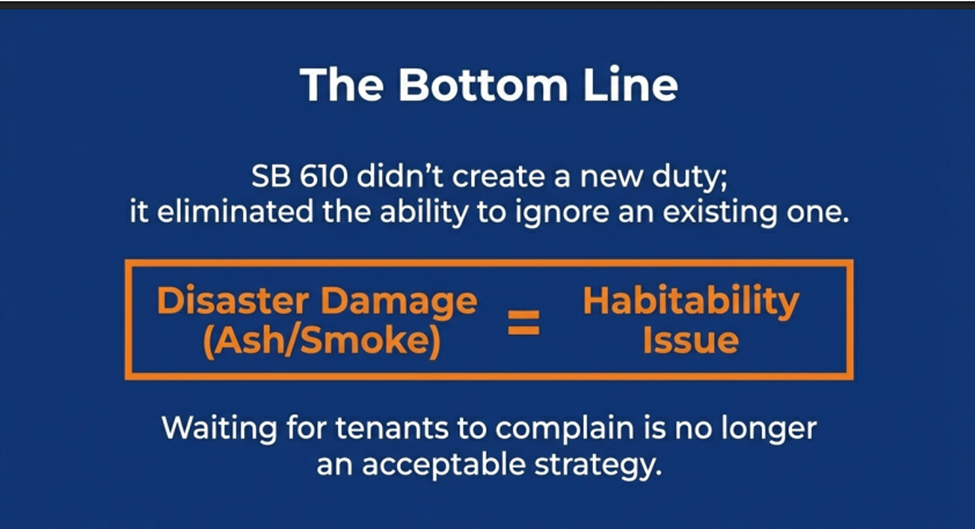
SB 610 did not create a new obligation so much as it eliminated the ability to avoid an existing one. Landlords have always been responsible for maintaining habitable conditions. What SB 610 did was make clear that disaster damage—smoke, ash, mold, asbestos—falls squarely within that responsibility, and that waiting for tenants to complain or local officials to figure out the guidance is not an acceptable approach.
If you own rental property in Los Angeles County, especially in fire-adjacent areas, the time to prepare is now—before the next fire, not after.
If you want to establish a baseline condition report for your property—so you know exactly what was there before and what changed after a disaster—that is one of the things a property condition assessment is designed to do. It creates the documentation that SB 610 effectively requires you to have.
NS
Additional Resources
Related Articles
Contact
- Phone: (626) 214-5929
- Email: nathan@larentalinspections.com
Get Ahead of Your Inspection
Book an inspection today and get ahead of your inspection. We'll help you get the most out of your inspection.
Schedule InspectionQuestions?
Email: nathan@larentalinspections.com
Call/Text: (626) 214-5929
Serving all of Los Angeles County