
Table of Contents
- SB-721: Apartment and Rental Buildings
- SB-326: Condos and Homeowner Associations
- Side-by-Side Comparison
- Deadlines and the Recent Extension
- Who Is Allowed to Perform the Inspection
- How Much of the Building Gets Inspected
- Repair Timelines After the Inspection
- The Reserve Study Requirement for HOAs
- My building is mixed-use. Which law applies?
- Can the same person who inspects the building also do the repairs?
- My building was recently constructed. Do I still need an inspection?
- Does the SB-721 deadline extension apply to my condo building?
- Which elements are not covered by these laws?
Introduction
On June 16, 2015, a group of college students gathered on a sixth-floor balcony in Berkeley, California to celebrate a birthday. Within moments, the balcony gave way. Six people died. Seven more were injured. Investigators later found that the wooden joists holding up the balcony had been rotting for years, hidden behind waterproof cladding that no one had ever looked behind.
That tragedy changed California law. In the years that followed, the state passed two major inspection requirements: SB-721 and SB-326. Both laws require property owners to inspect the balconies, decks, stairways, and walkways attached to their buildings. But they apply to different types of properties, have different deadlines, and come with different rules.
If you own or manage a residential building in Los Angeles, this guide will help you figure out which law covers your property, what you need to do, and what happens if you do not act in time.
What Are SB-721 and SB-326?
Both laws share one core goal: to make sure the outdoor structures attached to residential buildings are safe. California passed SB-721 in 2018 and SB-326 in 2019 after a series of balcony and deck failures across the state.
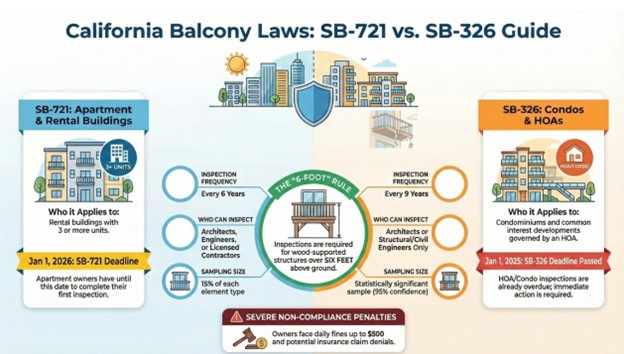
Both laws focus on what are called Exterior Elevated Elements, often shortened to EEEs. These include balconies, decks, porches, stairways, walkways, and entry structures that extend beyond the outer walls of a building. The rules apply when these structures are more than six feet above the ground and when they are supported, at least in part, by wood or wood-based materials.
Wood is the central concern here. When wood gets wet and stays wet, it rots. That rot can go unnoticed for years under waterproof finishes, paint, or cladding. By the time it is visible from the outside, the damage inside may already be severe. These laws require licensed professionals to inspect the structural elements that are most at risk.
Which Law Applies to Your Property?
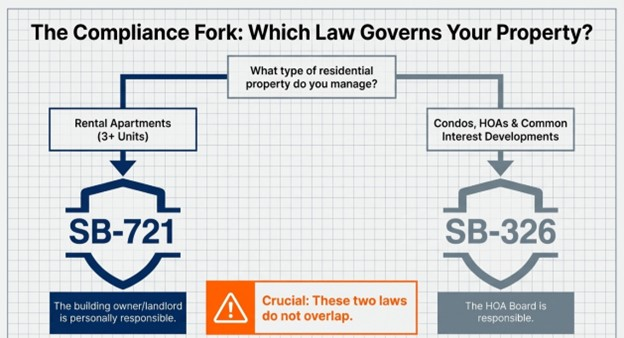
The most important thing to understand is that these two laws do not overlap. One applies to apartment buildings. The other applies to condominiums and homeowner associations. Here is a simple breakdown.
SB-721: Apartment and Rental Buildings
SB-721 covers apartment buildings with three or more units that are rented out. If you own a triplex, a twelve-unit building, or anything in between and you rent those units to tenants, SB-721 is your law.
As the building owner or landlord, you are personally responsible for scheduling the inspection and making sure it happens on time. The law requires inspections every six years.
SB-326: Condos and Homeowner Associations
SB-326 covers condominiums and common interest developments. If your building is governed by an HOA, this is the law that applies to your shared exterior structures.
Under SB-326, the HOA board is responsible for compliance. The inspection findings must also be included in the association’s reserve study, which is the financial planning document that maps out how the HOA will fund future repairs.
Side-by-Side Comparison
Use this table to quickly see how the two laws compare:
| Feature | SB-721 (Apartments) | SB-326 (Condos / HOAs) |
| Property Type | Rental buildings with 3 or more units | Condos, HOAs, common interest developments |
| Inspection Frequency | Every 6 years | Every 9 years |
| Inspection Sampling | Minimum 15% of each element type | Statistical sample at 95% confidence level |
| Who Can Inspect | Architects, engineers, contractors (A/B/C-5) | Licensed architects or structural/civil engineers only |
| Current Deadline | January 1, 2026 | January 1, 2025 (already passed) |
| Repair Timeline | 120 days to permit, 120 days to complete | As soon as reasonably possible |
| Reserve Study Required | No | Yes |
Key Differences You Need to Know
Deadlines and the Recent Extension
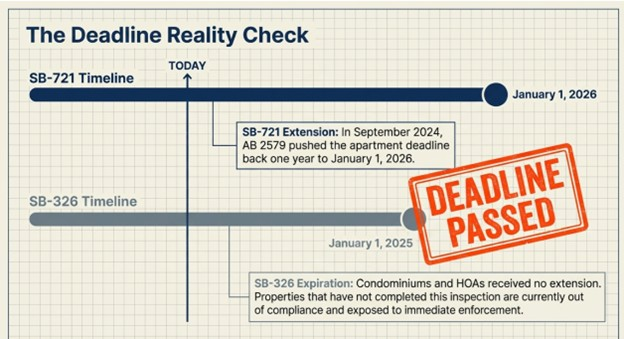
The original deadline for SB-721 was January 1, 2025. In September 2024, California passed Assembly Bill 2579, which pushed the SB-721 deadline back to January 1, 2026. This extension applies only to apartment buildings under SB-721.
The SB-326 deadline for condominiums and HOAs was January 1, 2025, and it was not extended. If your HOA has not completed its inspection yet, you are already past the deadline and need to act right away.
Who Is Allowed to Perform the Inspection
The two laws have different rules about who can carry out an inspection, and this is a detail that catches many property owners off guard.
For SB-721 apartment buildings, the inspection can be done by a licensed architect, a licensed structural engineer, or a general contractor who holds an A, B, or C-5 license and has at least five years of relevant experience.
For SB-326 condos and HOAs, the rules are stricter. Only a licensed architect or a licensed structural engineer can perform the inspection. Contractors are not allowed. Senate Bill 2114 later expanded this list to include licensed civil engineers, but the pool of qualified inspectors is still more limited than it is for SB-721.
Before you hire anyone, check their license type and make sure it matches the law that applies to your property.
How Much of the Building Gets Inspected
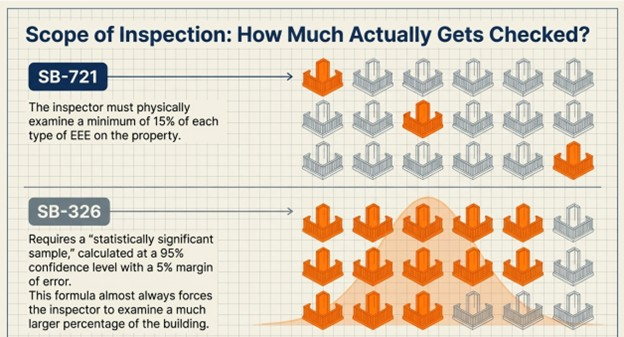
The two laws also differ in how much of the building the inspector must examine.
Under SB-721, the inspector must look at a minimum of 15 percent of each type of exterior elevated element. For example, if your building has 20 balconies, at least 3 of them must be fully inspected, including their structural components.
Under SB-326, the inspector must use a statistically significant sample, calculated at 95 percent confidence with a 5 percent margin of error. In practice, this method often results in a larger percentage of elements being inspected than the 15 percent minimum under SB-721.
Repair Timelines After the Inspection
If the inspector finds an immediate safety hazard, both laws require the inspector to notify the building owner or HOA board and the local building official in writing within 15 days. The building owner must also take immediate steps to prevent access to the unsafe structure.
Under SB-721, once a hazard is identified as non-emergency, the building owner has 120 days to apply for a repair permit and another 120 days after that to complete the repairs.
SB-326 does not set the same fixed deadlines for non-emergency repairs. Instead, it requires the HOA to make repairs as soon as reasonably possible. However, the lack of a hard deadline does not mean the HOA can delay. Regulators and courts take non-compliance seriously.
The Reserve Study Requirement for HOAs
One requirement that is unique to SB-326 is the connection to the HOA reserve study. After the inspection is complete, the HOA board must take the findings and incorporate them into the association’s reserve study.
A reserve study is a long-term financial plan that estimates the cost of future repairs and tells the HOA how much money it needs to collect from homeowners each month. If the inspection finds that balconies or stairways will need major repairs in the next ten years, that cost needs to be built into the reserve funding plan.
This requirement is designed to make sure that HOAs do not discover a major structural problem and then find themselves without the money to fix it.
What Happens If You Do Not Comply in Los Angeles
Ignoring these inspection requirements is not a risk worth taking. The consequences in Los Angeles can be serious.
- Local code enforcement officers can impose daily fines. Penalties typically range from $100 to $500 per day until the inspection is completed and any hazardous conditions are resolved.
- For HOAs that missed the SB-326 deadline, daily fines of up to $500 are already possible, and non-compliance can be used as evidence of negligence in any future injury lawsuit.
- If an inspection reveals that a structure is unsafe, the city can issue an unsafe structure order or a no occupancy order. This can bar residents from using balconies or, in serious cases, from occupying parts of the building.
- Insurance companies may deny claims for injuries or property damage if they find that the loss was connected to a failure to comply with these inspection laws.
- If you sell your building before the first inspection cycle is complete, you may be required to disclose this fact to buyers, which can affect the sale price and your liability.
Step-by-Step: How to Get into Compliance
- Figure out which law applies to you. Is your property a rental apartment building with three or more units? That is SB-721. Is it a condo building or governed by an HOA? That is SB-326.
- Confirm your deadline. Apartment owners under SB-721 have until January 1, 2026. HOAs and condo associations under SB-326 had a deadline of January 1, 2025, which has already passed.
- Hire the right inspector. Ask to see their license and verify that it is the right type for your law. A contractor who is qualified under SB-721 is not automatically qualified to inspect a condo building under SB-326.
- Do not wait. As more property owners in Los Angeles try to schedule inspections before the deadline, qualified inspectors will get booked up. Prices will go up and wait times will stretch out. The earlier you act, the better.
- Review the report and take action. If the inspector finds an immediate safety hazard, restrict access right away and start the repair process. For non-urgent findings, follow the required timelines for permits and repairs.
- Keep good records. Save your inspection report, all repair invoices, contractor information, and photos of the work. You are required to keep these records for at least two full inspection cycles.
- Mark your next inspection date. Put the next required inspection date on your calendar now. SB-721 requires a new inspection every 6 years. SB-326 requires one every 9 years.
Los Angeles-Specific Considerations
Los Angeles has one of the largest stocks of older apartment buildings in the United States. Many of them were built in the 1960s, 1970s, and 1980s with wood-framed balconies and walkways that have never been formally inspected for hidden decay. This makes SB-721 especially important for LA landlords.
The Los Angeles Department of Building and Safety, known as LADBS, is responsible for local enforcement. The department has the authority to issue citations, impose fines, and post properties as unsafe. LA is an active enforcement city, and property owners should not assume that violations will go unnoticed.
The competition for qualified inspectors in the LA region is real. There are many buildings that need inspections and a limited number of licensed professionals who are qualified and experienced in this type of work. If you are an apartment owner with an SB-721 deadline coming up in January 2026, do not assume you can find someone on short notice in November or December of 2025.
For HOAs in LA’s dense condo markets, the SB-326 reserve study connection has added a financial planning challenge. Many associations are finding that the cost of balcony repairs was not adequately funded in their previous reserve studies. If that is the case for your HOA, the board should work with a reserve study specialist to update the financial plan as soon as the inspection report is in hand.
Frequently Asked Questions
My building is mixed-use. Which law applies?
It depends on the ownership structure. If the residential units are rented out by a single owner or landlord, SB-721 most likely applies. If the residential portion is made up of individually owned condos within an HOA, SB-326 applies to the common exterior elements. In some cases, both laws may apply to different parts of the same property. When in doubt, consult a licensed attorney or a building code specialist.
Can the same person who inspects the building also do the repairs?
Yes. SB-721 was originally written to prevent this, but SB-607, passed in 2021, removed that restriction for apartment buildings. Under current law, a licensed contractor can both inspect and perform repairs on exterior elevated elements at multifamily apartment buildings. There is no such restriction under SB-326 either, though using separate parties for inspection and repair is often recommended as a best practice.
My building was recently constructed. Do I still need an inspection?
If your building received its certificate of occupancy on or after January 1, 2019, you have a six-year window before your first inspection is required. However, you should still confirm the exact timeline with LADBS and note the date so you do not miss your first required cycle.
Does the SB-721 deadline extension apply to my condo building?
No. The extension to January 1, 2026 only applies to apartment buildings covered by SB-721. The SB-326 deadline for condominiums and HOAs was January 1, 2025 and was not extended. If your association has not yet completed its inspection, you are out of compliance and should prioritize this immediately.
Which elements are not covered by these laws?
Exterior elevated elements that are less than six feet above ground level are generally not covered. Structures that are not supported by wood or wood-based products are also outside the scope of both laws. If you are unsure whether a specific structure on your property is covered, a licensed structural engineer can review it and give you a clear answer.
Check Your Property Compliance Today
Two laws. Two types of properties. One goal: making sure that the people who live in California residential buildings are safe on their balconies, decks, and stairways.
Whether you own a 10-unit apartment building in Silver Lake or sit on the board of a condo HOA in Santa Monica, you need to know which law applies to you, when your deadline is, and what your inspection needs to cover. That information is now in your hands.
The risks of doing nothing are real. Fines, legal liability, insurance problems, and the possibility of a serious injury on your property are all on the table. The process of getting into compliance is straightforward once you know where to start.
If you are ready to take the next step, start by confirming your property type and then reaching out to a licensed inspector who is qualified under the right law. Check your compliance status today and give the residents of your building the safety they deserve.
Get Ahead of Your Inspection
Book an inspection today and get ahead of your inspection. We'll help you get the most out of your inspection.
Schedule InspectionQuestions?
Email: nathan@larentalinspections.com
Call/Text: (626) 214-5929
Serving all of Los Angeles County