

Table of Contents
- Table of Contents
- You Own Rental Property and Haven’t Walked Every Unit in Years
- You’re Planning Renovations and Want to Prioritize
- You Just Inherited a Property and Don’t Know What You Have
- A Tenant Has Filed a Complaint or Withheld Rent
- You Manage a Portfolio and Need Annual Condition Tracking
- You Want to Know What a Buyer’s Inspector Will Find Before You List
- A Turnover Is Coming and You Need Move-In/Move-Out Documentation
- What Makes an Advisory Inspection Different
- Additional Resources
- Related Articles
- Contact
Table of Contents
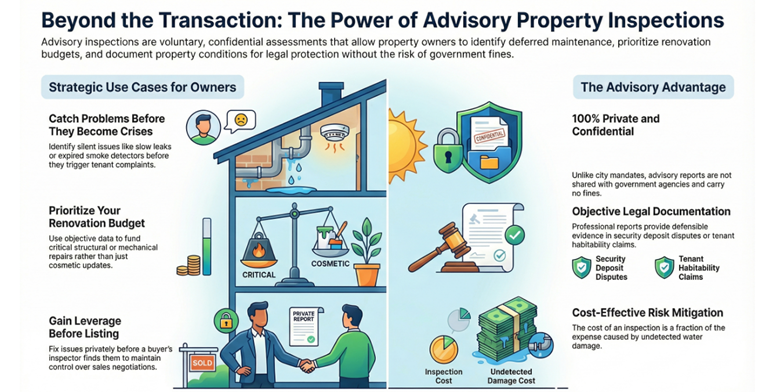
Most people think of property inspections as something that happens during a real estate transaction or when the County sends a notice. Buy a home, get an inspection. Receive an RHHP letter, get an inspection. Otherwise, why would you?
In practice, some of the most valuable inspections I do have nothing to do with a transaction or a mandate. They’re advisory—done because the owner wants to understand their property’s actual condition, make informed decisions about what to spend money on, or get ahead of a problem before it becomes a crisis.
Here are the situations where an advisory inspection consistently proves worth the cost.
You Own Rental Property and Haven’t Walked Every Unit in Years
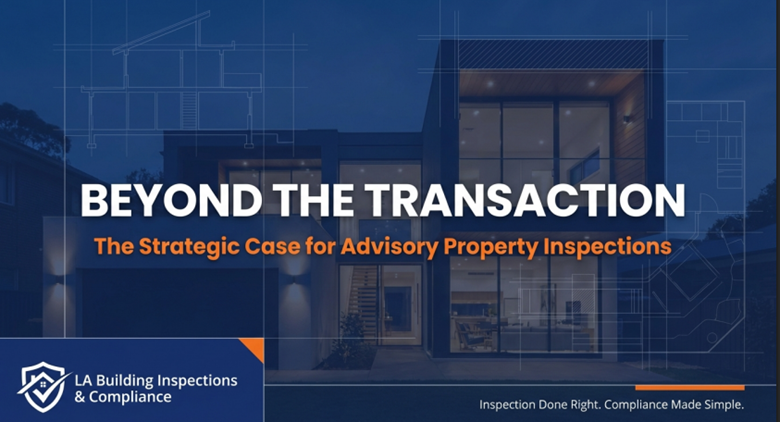
This is more common than most landlords admit. You have long-term tenants, the rent comes in, and nobody complains. But the absence of complaints is not the same as the absence of problems. Slow plumbing leaks cause water damage behind walls. GFCI outlets fail silently. Smoke detectors expire. Tenants adapt to small issues and stop noticing them.
An advisory inspection walks every unit with professional eyes and gives you a complete picture of deferred maintenance—before a tenant complaint, a code enforcement visit, or an RHHP inspection forces the issue on someone else’s timeline.
What you get: A prioritized maintenance list, estimated costs, and the ability to plan and budget repairs rather than react to emergencies.
You’re Planning Renovations and Want to Prioritize
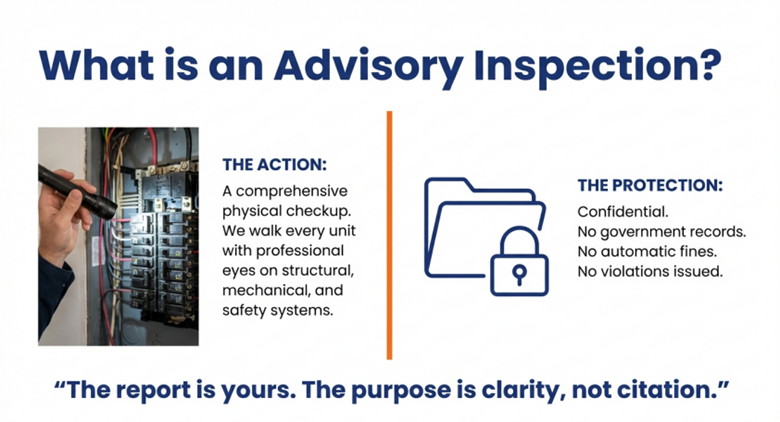
You have a renovation budget but you are not sure where it should go. New windows or new plumbing? Address the electrical panel or the roof? Many property owners spend money on visible improvements—kitchens, paint, flooring—while structural and mechanical systems go unaddressed.
An advisory inspection gives you objective information about what actually needs attention. It helps you allocate renovation dollars to the items that matter most for safety, compliance, and long-term value—not just the items that photograph well.
What you get: A clear understanding of which systems are aging, which are at risk of failure, and which cosmetic improvements are masking real problems.
You Just Inherited a Property and Don’t Know What You Have
Inherited properties often come with incomplete records, unknown modifications, and decades of deferred maintenance. The previous owner may have done work without permits, let systems deteriorate, or accumulated code compliance issues that were never addressed.
Before you decide whether to keep, rent, sell, or renovate an inherited property, you need to understand its actual condition and compliance status. An inspection tells you what you are working with and what it will take to bring the property into usable shape.
What you get: A baseline condition report that informs your hold/sell/renovate decision with real data instead of guesswork.
A Tenant Has Filed a Complaint or Withheld Rent
When a tenant files a habitability complaint or withholds rent, the landlord’s first instinct is often to respond emotionally. A better approach: get an objective assessment of the actual condition. If the complaint is valid, you know exactly what needs to be fixed and can address it promptly. If the complaint is exaggerated or inaccurate, you have documentation to support your position.
A third-party inspection report carries more weight than your own walkthrough in any dispute, whether with a tenant, an attorney, or a housing authority.
What you get: Documented, objective evidence of property conditions that can be used in dispute resolution, mediation, or legal proceedings.
You Manage a Portfolio and Need Annual Condition Tracking
Property management firms that handle multiple buildings often use annual or biannual inspections to track conditions across a portfolio. This is not about finding violations—it is about preventing them. Systematic inspections catch small problems (a leaking flapper valve, a missing outlet cover, early signs of mold) before they compound into expensive repairs or compliance failures.
For firms managing properties subject to RHHP, SCEP, or SB 721, annual condition tracking also ensures that nothing surprises you when the official inspection arrives.
What you get: A consistent maintenance baseline across your portfolio, with year-over-year comparison and a documented maintenance history.
You Want to Know What a Buyer’s Inspector Will Find Before You List
Sellers who get inspected before listing almost always come out ahead. They can fix issues quietly, price the property accurately, and avoid the negotiation leverage that a buyer’s inspection report creates. A pre-listing advisory inspection shows you exactly what a buyer’s inspector will find—and gives you the chance to address it first or disclose it strategically.
What you get: Control over the narrative. You decide what to fix, what to disclose, and what to price in—instead of reacting to the buyer’s inspector’s report.
A Turnover Is Coming and You Need Move-In/Move-Out Documentation
California’s security deposit laws require specific documentation of unit condition at move-in and move-out. Disputes over security deposit deductions are among the most common landlord-tenant conflicts. Photographic documentation and a condition report at each turnover protects both parties and gives you defensible records if the deduction is challenged.
What you get: Timestamped, photographic documentation of unit condition that holds up in deposit disputes and small claims proceedings.
What Makes an Advisory Inspection Different
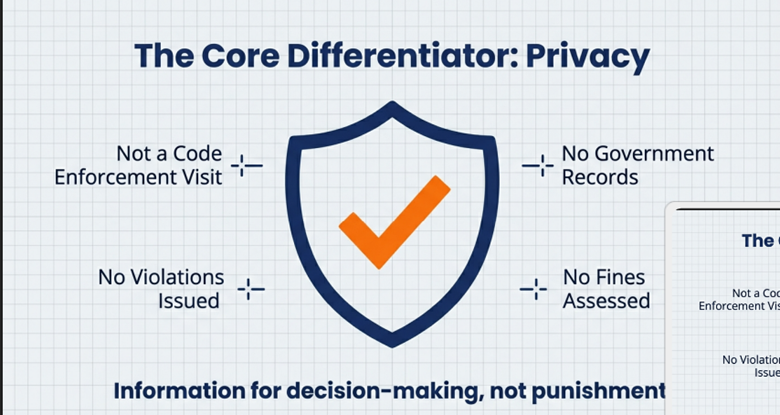
An advisory inspection is not a code enforcement visit. Nothing goes on record with any government agency. No violations are issued. No fines are assessed. The report is yours, and it is confidential.
The purpose is not to pass or fail your property. It’s to give you accurate information about its condition so you can make better decisions. Sometimes those decisions are about maintenance. Sometimes they are about timing a sale. Sometimes they are about protecting yourself from liability.
The common thread is this: property owners who know what they have make better decisions than property owners who are guessing. That’s true whether you own one rental unit or forty.
When It Pays for Itself
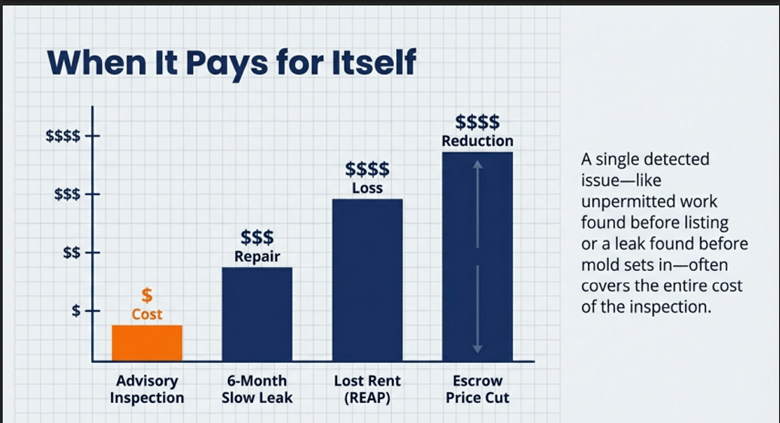
The cost of an advisory inspection is typically a fraction of what a single undetected issue can cost. A slow leak behind a wall that runs for six months causes more damage than a year of inspections. An RHHP violation that leads to REAP placement costs more in lost rent than a dozen pre-inspections. And the landlord who discovers unpermitted work before listing—rather than when the buyer’s inspector finds it during escrow—keeps the negotiation on their terms.
If any of these situations sound familiar, I am happy to talk through what an advisory inspection would look like for your property. No pressure, no sales pitch—just a conversation about whether it makes sense for your situation.
NS
Additional Resources
Related Articles
Contact
- Phone: (626) 214-5929
- Email: nathan@larentalinspections.com
Get Ahead of Your Inspection
Book an inspection today and get ahead of your inspection. We'll help you get the most out of your inspection.
Schedule InspectionQuestions?
Email: nathan@larentalinspections.com
Call/Text: (626) 214-5929
Serving all of Los Angeles County