

Table of Contents
- In This Article
- What Happened
- The Numbers: What This Actually Means
- Two Motions, Two Scopes
- Who Is Affected
- If you own rental property in unincorporated LA County
- If you own rental property in an incorporated city
- If you own property in both
- What Has Not Changed
- Why Landlords Are Concerned
- What You Should Do Now
- The Bigger Picture
- Additional Resources
- Related Articles
- Contact Information
Developing Story — Vote Pending February 10, 2026
On February 3, the LA County Board of Supervisors voted 4-1 to raise the eviction rent debt threshold from one month to two months in unincorporated areas. A second motion , expanding the threshold to three months and applying it countywide, is scheduled for a vote on February 10. This article reflects what has been approved and what is pending as of publication. We will update this post as the situation develops.
In This Article
- What Happened
- The Numbers: What This Actually Means
- Two Motions, Two Scopes
- Who Is Affected
- What Has Not Changed
- Why Landlords Are Concerned
- What You Should Do Now
What Happened
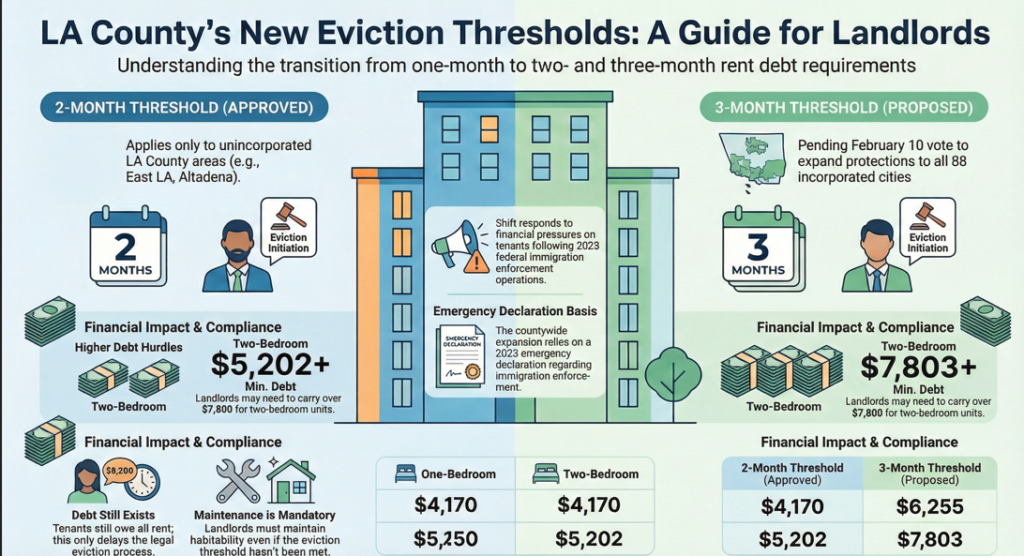
On February 3, 2026, the LA County Board of Supervisors voted 4-1 to direct County Counsel to draft an ordinance that raises the nonpayment eviction threshold from one month to two months of fair market rent. The motion was authored by Supervisors Janice Hahn and Hilda Solis. Supervisor Kathryn Barger cast the lone dissenting vote.
The stated reason: federal immigration enforcement operations that have been sweeping through Los Angeles County since the summer of 2025. Supervisors argued that ICE raids have discouraged some residents from going to work, disrupted businesses that have lost customers and workers, and put financial pressure on families who may fall behind on rent through no fault of their own.
But the bigger development came later that same afternoon. Supervisor Lindsey Horvath introduced a separate motion that would go further—raising the threshold to three months of fair market rent and applying it countywide, not just in unincorporated areas. That vote is scheduled for February 10.
The Numbers: What This Actually Means
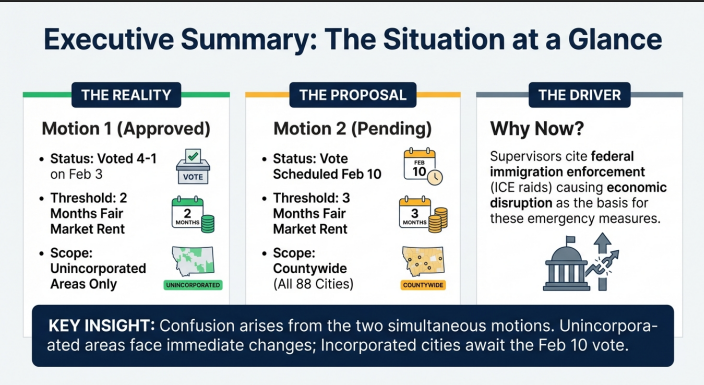
The threshold is tied to HUD’s Fair Market Rent for Los Angeles County, which is set annually. Here’s what it looks like in practice:
| Unit Type | Fair Market Rent | 2-Month Threshold | 3-Month Threshold (Proposed) |
| One-Bedroom | $2,085/mo | $4,170 | $6,255 |
| Two-Bedroom | $2,601/mo | $5,202 | $7,803 |
Under the two-month threshold that was already approved for unincorporated areas, a tenant in a two-bedroom unit can owe more than $5,200 before a landlord can begin eviction proceedings for nonpayment. If the three-month proposal passes on February 10, that number rises above $7,800.
To be clear: tenants still owe the rent. This is not rent forgiveness. The threshold determines when a landlord can initiate the legal eviction process, not whether the rent is due.
Two Motions, Two Scopes
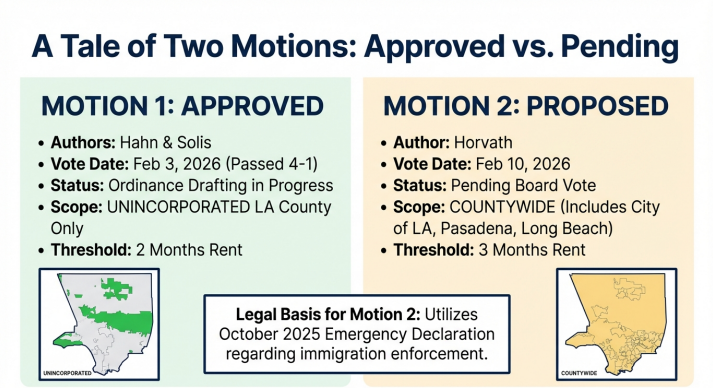
There are two separate proposals moving through the Board simultaneously. They’re not competing, Supervisor Horvath said she supports both , but they have different scopes and timelines.
Motion 1: Hahn/Solis (Approved February 3)
- Threshold: Two months of fair market rent
- Scope: Unincorporated LA County only
- Status: Approved 4-1. County Counsel is drafting the ordinance, with a final vote expected within 30 days.
- Basis: Amends the existing County Rent and Tenant Protections Ordinance
Motion 2: Horvath (Vote February 10)
- Threshold: Three months of fair market rent
- Scope: Countywide, all 88 incorporated cities plus unincorporated areas
- Status: Scheduled for vote February 10. If approved, County Counsel would draft a resolution by March 3.
- Basis: Uses the County’s emergency declaration (issued October 2025 in response to immigration enforcement) to extend protections beyond unincorporated boundaries
The countywide expansion under Motion 2 is the one generating the most debate. Supervisors Hahn and Solis have argued the County lacks authority to impose tenant protections on incorporated cities. Horvath disagrees, citing the emergency declaration as the legal basis. If Motion 2 passes, expect legal challenges.
Who Is Affected
If you own rental property in unincorporated LA County
You’re directly affected by Motion 1, which has already been approved. Once the ordinance is finalized (expected within 30 days), the two-month threshold will apply to your properties. If you are in an unincorporated area , East Los Angeles, Altadena, Lennox, Florence-Firestone, Hacienda Heights, Willowbrook, and others—this is your new reality.
These are the same areas covered by the RHHP inspection program. If your property is subject to RHHP, it is subject to this ordinance change.
If you own rental property in an incorporated city
You’re not affected yet. Motion 1 doesn’t apply to you. But if Motion 2 passes on February 10, the three-month threshold would extend to properties in the City of Los Angeles, Pasadena, Glendale, Long Beach, and every other incorporated city in the county. Watch the February 10 vote closely.
If you own property in both
You may soon be operating under two different eviction thresholds depending on where each property is located. Track your properties by jurisdiction.
What Has Not Changed
You need to know what this change does and doesn’t do:
- Tenants still owe the rent. The threshold doesn’t forgive unpaid rent. It determines when eviction proceedings can begin, not whether the debt exists.
- Lease terms still apply. Late fees, lease violation notices, and other contractual provisions remain enforceable as written.
- Just-cause eviction rules are unchanged. Evictions for lease violations, nuisance, or other just causes under AB 1482, RSO, or local ordinances are not affected by this threshold change.
- Habitability requirements are unchanged. RHHP, SCEP, and all habitability obligations remain fully in effect regardless of whether rent is being collected.
That last point matters. Even if a tenant falls behind on rent, you are still responsible for maintaining habitable conditions. Deferred maintenance is not a negotiating tool , it is a compliance violation that can trigger REAP, fines, and additional legal exposure.
Why Landlords Are Concerned
The California Apartment Association and individual landlords have pushed back on both motions. Their concerns center on a few key points:
Cash flow impact on small landlords. A two- or three-month rent gap hits hardest on owners with one or two properties who depend on rental income to pay their own mortgages, taxes, and maintenance costs. Supervisor Barger has previously voiced concern about “mom-and-pop” owners being caught in the middle.
COVID-era parallels. Landlord groups cite the pandemic-era eviction moratorium as a cautionary example, noting that many tenants never repaid deferred rent, leaving property owners carrying the debt for years.
Countywide overreach. Applying the threshold to all 88 incorporated cities through an emergency declaration—rather than letting each city set its own policy , raises questions about scope of authority and may trigger legal challenges.
Supervisor Hahn acknowledged this tension directly, saying she expected “backlash from both sides” and calling the two-month threshold a “middle ground.”
What You Should Do Now
For All LA County Landlords
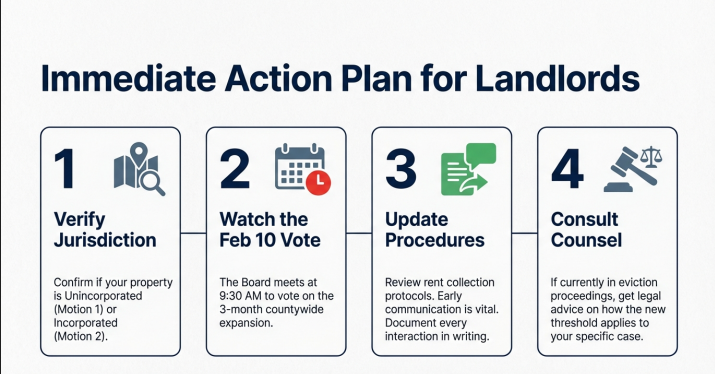
- Watch the February 10 vote. If the three-month countywide motion passes, every rental property owner in the county is affected. The Board meets at 9:30 a.m. at Kenneth Hahn Hall of Administration.
- Know which jurisdiction your properties are in. If you are unsure whether your property is in an unincorporated area, use the LA County Public Works Service Locator.
- Review your rent collection procedures. With a higher threshold before you can begin eviction, early communication with tenants who fall behind becomes even more important. Document everything in writing.
- Do not defer maintenance as leverage. Withholding repairs because a tenant is not paying rent creates habitability violations that will go on record during RHHP or SCEP inspections. This creates a worse problem than unpaid rent.
- Know about available programs. LA County launched an Emergency Rent Relief Program in late 2025. If your tenant qualifies, the program can pay you directly. Contact DCBA at 800-593-8222 or visit stayhousedla.org.
- Consult your attorney. If you are currently in an eviction process or considering one, get legal advice on how the new threshold affects your case.
The Bigger Picture
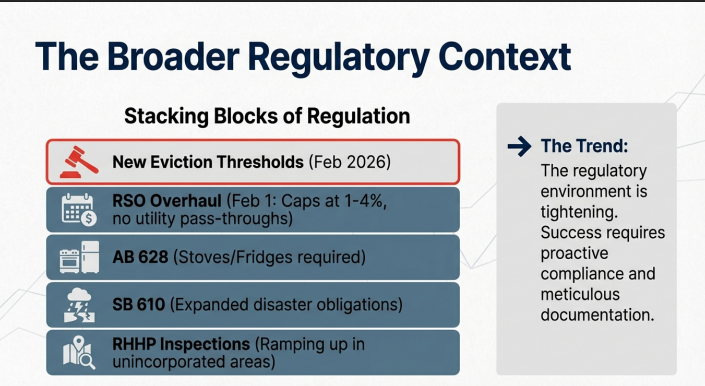
This is part of a broader trend. The RSO overhaul took effect February 1, capping increases at 1–4% and eliminating utility pass-throughs. AB 628 now requires stoves and refrigerators in all rental units. SB 610 expanded landlord obligations after disasters. RHHP inspections are ramping up across unincorporated areas.
The regulatory environment for LA landlords is getting tighter, not looser. The landlords who are managing this well are the ones who stay current on compliance, maintain their properties proactively, and document everything. That has not changed.
If you are in an RHHP area and are worried about how these changes stack up with your existing compliance obligations, that is exactly what preparation inspections are for. We help you identify and fix issues before they go on record , so when things get complicated, your property is not the complication.
We Will Update This Post
The February 10 vote could change the scope of this policy significantly. We will update this article after the vote with the outcome and any additional guidance for landlords. Check back or contact us with questions.
NS
Additional Resources
Related Articles
Contact Information
- Phone/Text: (626) 214-5929
- Email: nathan@larentalinspections.com
- Website: labuildinginspections.com
Get Ahead of Your Inspection
Book an inspection today and get ahead of your inspection. We'll help you get the most out of your inspection.
Schedule InspectionQuestions?
Email: nathan@larentalinspections.com
Call/Text: (626) 214-5929
Serving all of Los Angeles County